What is a finding aid?
A guide to accessing information in the Museums Victoria Archives.
Finding aids describe an archival collection, including a listing or index of holdings. They include a brief history, to help navigate the types of information and context of the archival collection and identify material relevant to the researcher.
Introduction to The Forest Gallery
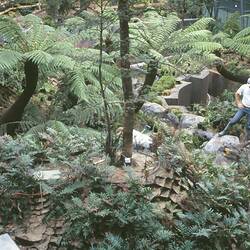
Melbourne Museum is unique amongst museums worldwide for having a Forest Gallery in the middle of the museum with live flora and fauna on display. Very few examples of museums come close to such a unique exhibition gallery. Originally the Forest Gallery was called Gallery of Life in the documentation during the development phase, but the name was changed to the Forest Gallery when the Melbourne Museum opened its doors in Carlton Gardens on 21 October 2000.
In the early development of the Forest Gallery, the Annual Report from 1994-5 notes: "This unique facility will exhibit living Victorian flora and fauna. The Gallery of Life will educate visitors on the natural environment's ecological processes. The structure of a forest will be recreated with a minimum number of representational species" (p13 Annual Report 1994-5).
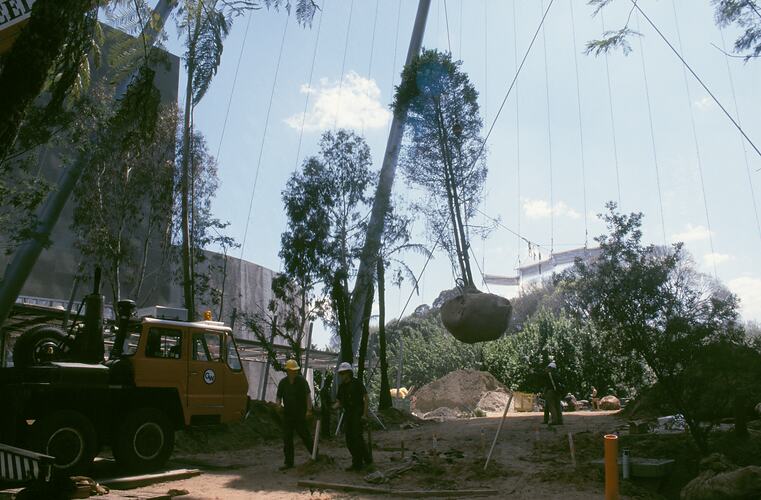
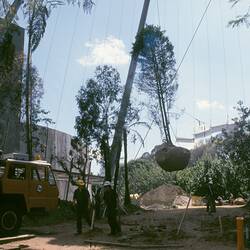
"During the year, a contractor was engaged to select and maintain a range of mature native trees, salvaged from forest logging blocks, which will ultimately be transplanted in the Gallery of Life. The Museum is liaising with the Royal Melbourne Zoo in the development of operational procedures for the Gallery of Life, and landscape architects soon to be appointed" (p20). The Forest Gallery "will enable visitors to explore a living flora and fauna environment representing the character of the tall forests of south-eastern Victoria" (p18 Annual Report 1996-7).
The Forest Gallery is managed by the Museum's Live Exhibits team, who maintain it seven days a week. As the gallery was designed as a fully immersive, dynamic gallery that will 'grow' and change over time, the team carry out an onsite review with a landscape architect each year to ensure ongoing maintenance continues to align with the intended design vision and narrative of the original gallery concept.
The Forest Gallery is better understood as a terrarium than as a garden; it is an artificial environment where all aspects are manipulated and controlled, from substrate to rainfall. It is the only surviving simulation of a tall mountain forest and wet Myrtle Beech Forest ecosystem in an inner-city environment. Within the Forest Gallery are the tallest moss species in the world and the tallest flowering species of plant in the world, the giant moss Dawsonia superba and the mountain ash Eucalyptus regnans. The gallery also contains several threatened plant species, and an important aspect of Live Exhibits' work is propagating key species as nursery stock are too generic to represent the fauna of Victoria.
Since the start of the gallery's development, several stakeholders have carried out important work in the Forest Gallery. Museums Victoria engages a plant health pathologist to assess foliar health, soil health, and pH levels, and to monitor overall tree growth. As the forest has grown in the space, arborists are employed each year to cut the trees to height so that they do not outgrow the Forest Gallery roof, as well as carrying out, formative shaping, and safety pruning of trees and large shrubs. All findings are compiled into an annual report, which includes recommendations that the Live Exhibits team follow closely to guide fertilising, drenching, and maintenance activities in specific areas as required. Wind alarms have been installed to provide warning of dangerous conditions in the Forest Gallery during high winds.
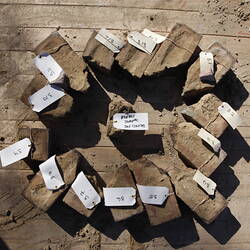
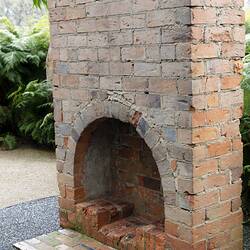
In addition to the native plants and animals, the Forest Gallery has the following installations; the Victorian Bushfire Collection Chimney from the Kinglake Black Saturday 2009 fire; the Sacred Tree of Our Songlines by Robert Young; and Biik Milboo Dhumba / Country is Always Talking display panels where visitors can scan QR codes and listen to stories shared by people from the Easter Kulin Nations.
Summary of the Forest Gallery (1994-2024) Finding Aid
Extent
42 boxes
35 files & documents
Repository
Museums Victoria Archives Melbourne Museum
Provenance
Records created by Museums Victoria staff (1994 - 2024).
Holdings
To view list of holdings, see 'Associated Downloads' section.
Major Holdings
- Agendas, minutes and papers
- Blogs
- Briefings
- Correspondence
- Design meetings
- Education programs and kits
- Exhibition files
- Operational guidelines
- Pressed plant specimens
- Promotional material
- Redevelopment planning report
- Specifications, briefs, and construction advice
- Workshops
Related Collections/Links
Chimney - 'The Uplands', Kinglake, 07 Feb 2009 (Bushfire Damaged)
Stories Revealed Through Bricks & Mortar
Biik Milboo Dhumba | Country Is Always Talking
The Sacred Tree of Our Songlines by Robert Young
Access
Access to the Museums Victoria Archives is by appointment an Ask Us access enquiry.
Please provide as much information about your enquiry as possible. Such as:
- names (e.g., past or current staff, collector, research associate, honorary associate)
- dates (including year and month, if available)
- place names
- information about the discipline or collecting area
- purpose of enquiry
This information will assist the Ask Us team and Archivist to answer the enquiry.
More Information
-
Keywords
-
Authors
-
Article types