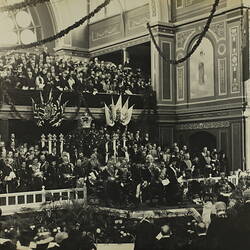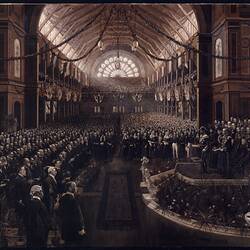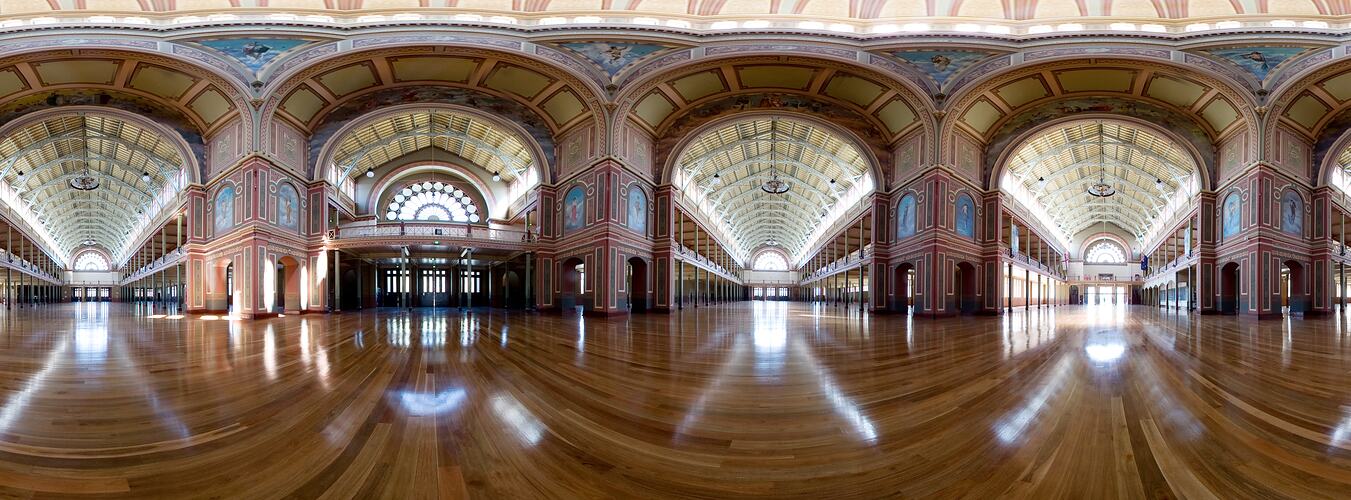
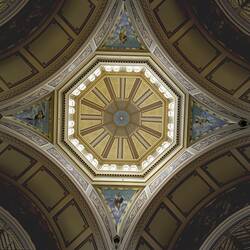
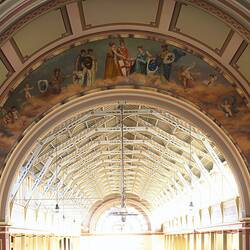
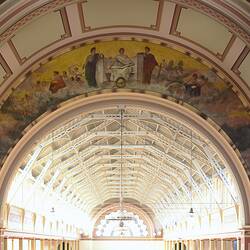
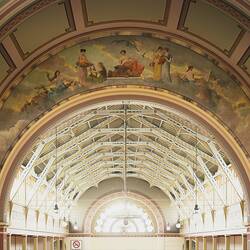
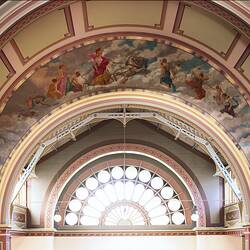
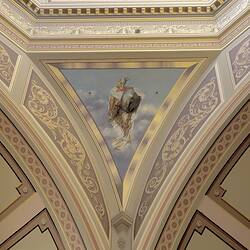
Designed by John Ross Anderson for the opening of Federal Parliament in 1901 the current interior decorative scheme is the third of the Royal Exhibition Building's interior decorative schemes and is considered to be one of the finest examples of Anderson's work. The brown, red and green colours suited the solemn occasion, while the artwork is rich in symbolism relating to the Federation of Australia.
Commenting on the scheme at the time, The Age noted 'Mr J. Ross Anderson, whose design was accepted in open competition.has succeeded in imparting to the building an exceedingly rich and pleasing effect, very different from the glaring colors used previously, the colors, now used being adapted to public functions and the special requirements of the present festivities' (The Age, 7 May 1901, p.6).
To complete the work quickly Anderson employed a team of painters, decorators, and artists who finished the work in under four months. He also made use of stencils for the largely repetitive decoration in the nave and transepts. This was in contrast to the dome which was mostly hand painted with the main figures painted by notable artists of the day - Gordon Coutts, George Dancey, Leon Pole and Girolamo Nerli.
The dome's radial design in blue and gold tones is intended to represent the sky. This followed the work of the two earlier decorative schemes. Under the dome are four Latin mottos inspired by Horace (a Roman poet) and the Stoics (an ancient Greek philosophy) intended to reflect ideals and hopes for the new nation of Australia. Carpe diem - 'make the most of the day' or more popularly if incorrectly 'seize the day'; Dei gratia - 'by the grace of God'; Aude sapere - 'dare to be wise'; and Benigno numine - 'with benign power'. Beneath the mottoes a garlanded frieze, containing the bounteous products of agriculture with melons, apples, pears, pomegranates and grapes, and pairs of overflowing cornucopia highlight the importance of agriculture for the new nation.
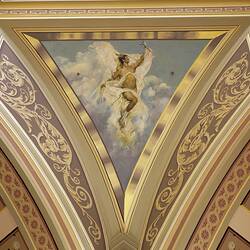
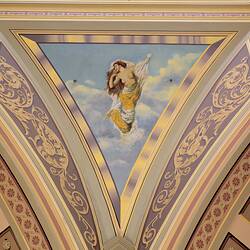
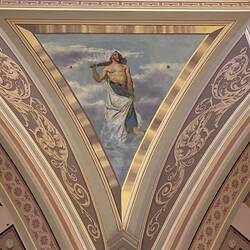
The pendentives, the triangular section of vaulting between the rim of the dome and each adjacent pair of arches, contain the figures of Venus, Mercury, Hercules and Mars painted by Girolamo Nerli. Reflecting on the use of Roman gods in the pendentives The Argus noted: 'their symbolical place in the Commonwealth scheme may not be too obviously apparent, but they may perhaps be taken to typify Australian strength and swift intelligence, combined with a manly appreciation of beauty, love, and war.'
Situated over each arch are the lunettes, a half-moon or semi-circular shaped architectural space with some form of ornamentation, which have pairs of complementary paintings. War and Peace, and Governance and Federation. All except Federation feature Minerva, the Roman goddess of wisdom, medicine, commerce, handicrafts, poetry, the arts and war, accompanied by her attendants engaged in activities appropriate to each subject - riding her chariot through storm clouds into battle, enjoying literature, painting, music and animal husbandry, or mathematics, geography, literature and the arts.In 'Federation' a helmeted Britannia holds a shield emblazoned with the Union Jack welcoming the six federated states. The states are depicted as virgins, each bearing a shield emblazoned with the state coats-of-arms. In the centre are Victoria and NSW. Behind NSW are Western Australia, Tasmania and finally South Australia. While Queensland stands next to Victoria.
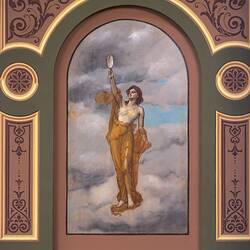
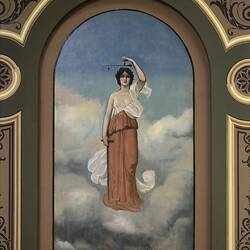
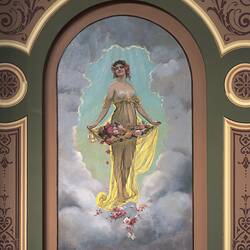
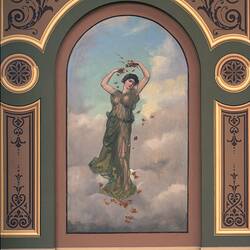
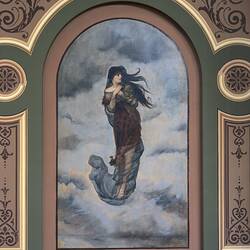
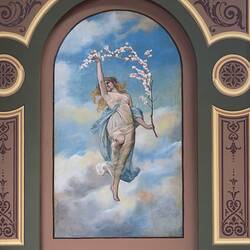
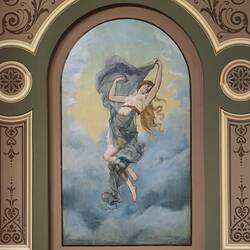
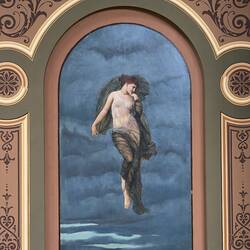
Finally on the spandrels of the dome are eight sylphs depicting truth, justice, morning, night, winter, spring, summer and autumn. Additional drapery was added to the sylphs after some of the trustees saw them and insisted they be more covered-up! However, as the Leader newspaper noted 'this prudery has not spoilt the artist's work, though it has minimised the beauty of the figures'.
More Information
-
Keywords
Royal Exhibition Building, Royal Exhibition Building: Dome, Royal Exhibition Building: History of Events, 1900-1949, Royal Exhibition Building: Architecture, Royal Exhibition Building: Construction, Royal Exhibition Building: Decorations, Royal Exhibition Building: Restoration, Royal Exhibition Building: Great Hall, Royal Exhibition Building, Royal Exhibition Building: Conservation
-
Authors
-
Article types