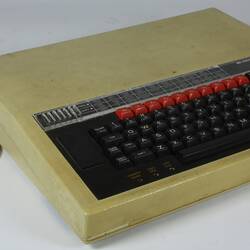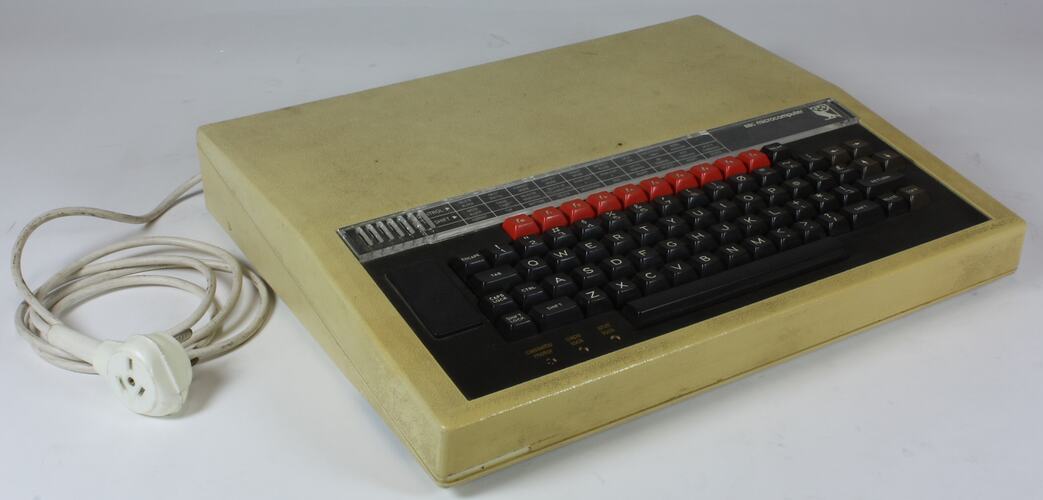
The BBC Microcomputer changed the world as we know it today through its descendants: the ARM microprocessors in most mobile phones, portable computing devices, car computers, medical devices, some desktop computers, and in some of the world's largest supercomputers. Paying tribute to the first BBC machines, early models in the Raspberry Pi range of single board computers are branded Model A and Model B.
The BBC Micro
Popularly known as the BBC Micro or the Beeb, it is sometimes incorrectly called the "Proton", which was the codename of a proof-of-concept development (designed and built at 4A Market Hill, Cambridge in the first four days of February 1981). That remarkable achievement convinced the BBC to choose Acorn out of a field of six contenders from Britain's emerging microcomputer industry.
The British Broadcasting Corporation chose Acorn Computers (a small British computer firm) to design and build the BBC Micro in support of the BBC Computer Literacy Project. Their award-winning television programmes were broadcast in the UK, Australia, New Zealand and the USA during the 1980s and 1990s. Strongly supported by the Thatcher Conservative Government, the BBC introduced concepts of the wired society to people who were largely unaware of microelectronics and the influence it would have on future generations.
Completely underestimating consumer interest, the BBC expected to sell about 20,000 units. Even though British consumers could buy a new refrigerator and a washing machine for the cost of a Model B computer, Acorn sold more than one million BBC-branded machines.
The design combines many firsts including local area networking, high resolution graphics (when most computers were still monochrome), speech synthesis, and the ability to connect a second processor, which allowed other computer operating systems to run.
For their contributions to science, industry and innovation, Acorn Directors Dr Hermann Hauser and Sir Andy Hopper were knighted, and lead designers Sophie Wilson and Professor Steve Furber were appointed Commanders of the Order of the British Empire (CBE); and all received other prestigious honours and awards.
BBC Micro Number #100002
Serial number #100002 is historically significant, being the only example of the first batch of 10 hand-assembled machines known to exist (numbered #100000 to #100009). Acorn released this first issue board (along with the keyboard and case) to meet Barson's commitments to the Western Australian Department of Education. The power supply and disk interface arrived several weeks later, just in time for the WA school computer tender evaluation.
The '1' in the serial number refers to the production plant where the printed circuit board was produced - in this case: Cleartone in Wales. Cleartone produced 275 of the Issue 1 boards for development, of which only a few still exist.
The components on the main circuit board were populated by the donor at Acorn in Cambridge. It shows signs of the work done to bring this pre-production unit to life during debugging in the workshops at Barson Computers in Abbotsford, Victoria. This included extra piggybacked components, a handmade heatsink to allow a custom chip to cope with an Australian summer, and jumper wires.
As a result of Barson's initiatives, disk storage and local area networking were released in Australia well ahead of the UK. The BBC Micro was the first to be approved by all Australian State Education Departments for use in schools.
More Information
-
Keywords
computing, Computing Technology, Computing, Computing Industry
-
Authors
-
Article types