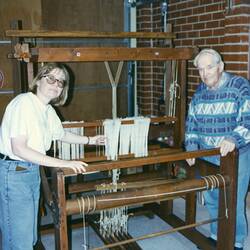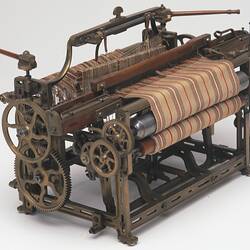


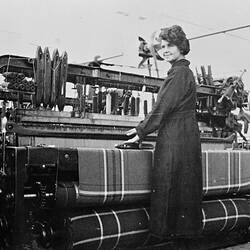
Weaving is one of the oldest activities that humans have performed, going back several thousands of years. The loom creates lightweight woven structures that can be draped (e.g. clothes) or folded and unfolded many times without deformation, and can be tensioned under loads (e.g., for sails and shelters). Interlacing the tensioned warp threads with the weft threads could be done manually by using a shuttle holding the weft thread. In 1733 this process was mechanized by using a 'flying shuttle' to automatically thread the weft thread into the warps threads, making it much quicker to create cloth.
The development of the automatic loom by Joseph-Marie Jacquard (1752-1834) automated the process of lifting the warp threads. An earlier innovation was to use a cylinder or drum with spokes on it to raise and lower hooks which opened the warp threads, much like popular music boxes of the time. But it was clumsy and slow. Jacquard brought together all the previous good ideas to construct a practical, rapid, efficient and flexible loom, moving it beyond a mechanical aid to a truly automatic machine. Jacquard's loom used punched cards 'programmed' to automatically lift the weft threads. This innovation made it possible to create patterned woven cloth at a rate that was 24 times faster than previously. Instead of 2.5 cm a day, it was possible to create 60 cm of cloth per day. The woven cloth also had patterns and images of such fine detail that it resembled painted pictures. Such automatic weaving machines, with their punch card instructions (patented by Jacquard in 1804), subsequently became known as precursors to the automatic computing machines of the 20th century. The punched cards were like a binary code, where instead of 1s and 0s, there were either holes or no holes and these corresponded to which warp threads would be lifted. At the time that they were introduced, looms that operated in this way were considered the most complex mechanisms in the world.
The idea of using binary code to represent more than just patterns was recognized by mathematician Ada Lovelace (early 19thC), who saw how it could represent complex mathematical algorithms by breaking down complex problems into a series of steps programmed into punched cards. Although never built, the idea of this form of coding (using punched cards inspired by Jacquard's loom), for the ingenious Analytic Engine machine developed by Charles Babbage, is considered the foundation of modern computer programming.
The space missions of the 1960s accelerated the development of computing, by the need to make electronic circuits and computers smaller to be carried onboard spacecraft. In the USA, the manufacture of core rope memory modules adapted the technique of weaving fibrous thread into cloth, to the weaving of wires through magnetic rings (cores) to create computer memory. Instead of punched cards, perforated tape was used to position the cores, but the repetitive work of weaving the wires was done by highly skilled, and meticulously accurate human hands.
References
Essinger, J. (2004) Jacquard's web : how a hand-loom led to the birth of the information age. Oxford: Oxford University Press.
Rees, Abraham (1819). Weaving, The Cyclopædia; or, Universal Dictionary of Arts, Sciences, and Literature. Longman, Hurst, Rees, Orme & Brown [etc.], p. 198, https://www.biodiversitylibrary.org/page/38760095. accessed 28 Mar 2025
Science and Industry Museum (2019). Programming patterns: the story of the Jacquard loom | Science and Industry Museum. [online] Science and Industry Museum. Available at: https://www.scienceandindustrymuseum.org.uk/objects-and-stories/jacquard-loom , accessed 28 Mar 2025
Handwoven Editors (2016), 'How weaving took us to the moon, accessed 28 Mar 2025, https://handwovenmagazine.com/weaving-history-core-rope-memory/
M. I. Kiron (2022), 'Basic Weaving Mechanism of Loom', Textile Learner, https://textilelearner.net/basic-weaving-mechanism-of-loom/, accessed 28 Mar 2025
Museums Victoria Collections, Core Memory Module, https://collections.museumsvictoria.com.au/items/389259 , accessed 31 Mar 2025
Marshall Cavendish Ltd, (1974-75), Loom, How It Works: The A to Z of invention, science and technology.
More Information
-
Keywords
-
Authors
-
Article types