Summary
Videotape of interviews with Anita Apinis Herman and Leopoldine Mimovich. The interview includes why they migrated to Australia, how they came to be artists, the processes and techniques used in their art, whether their art is traditional, contemporary or a mix of both, and their motivations and inspirations which inform their artistic practice.
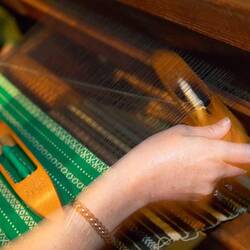
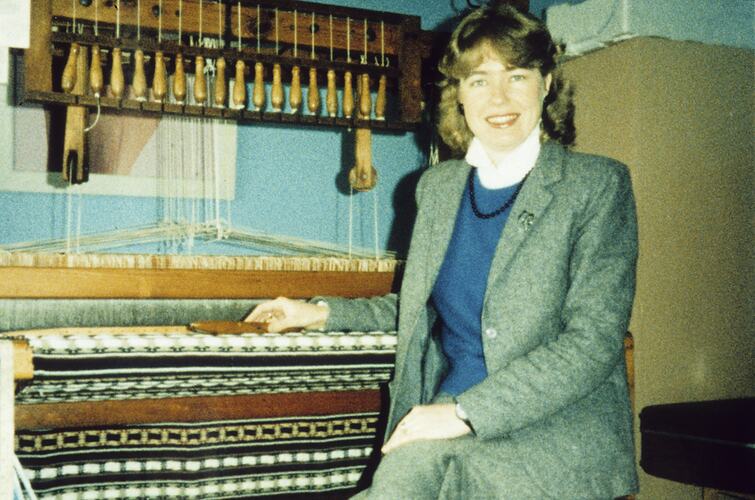
Anita is second generation Latvian weaver, she was taught by her mother Anna and then undertook further training at the Melbourne College of Textiles. Anita was born in Sydney in 1952 after her family had migrated from Latvia in 1950 following World War Two. Anita's mother Anna wove traditional Latvian costumes and fabrics and passed these skills onto Anita. Anita uses a mix of traditional and contemporary influences in her weaving, often mixing traditional Latvian designs with contemporary colours drawn from the Australian landscape.
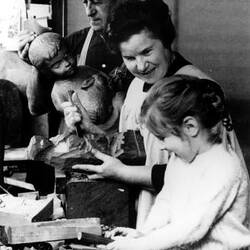
Leopoldine Mimovich is a sculptor and painter. She was born in the South Tyrol district of Austria (now Italy) and migrated to Australia in 1949. She had studied sculpting in Vienna and in Hallstatt and continued to sculpt in Australia. Her work explores mainly Christian themes and she has gained widespread recognition for her work within the Australian Christian community. Leopoldine arrived in Australian in 1949 with her husband, she had trained to be an artist in Austria first undertaking training with her father who was an interior decorator and then going to art school where she trained as a sculpture. Since she arrived in Australia Leopoldine's wood carving has changed from very Baroque in style to drawing move on influences from the Australian landscape.
Description of Content
Footage of interviews with Anita Apinis Herman and Leopoldine Mimovich. The interview includes why they migrated to Australia. How they came to be artists, the processes and techniques used in their art, whether their art traditional, contemporary or a mix of both, and their motivations and inspirations which inform their artistic practice. Anita was born in Sydney in 1952 after her family had migrated from Latvia in 1950 following World War Two. Anita's mother Anna wove traditional Latvian costumes and fabrics and passed these skills onto Anita. Anita uses a mix of traditional and contemporary influences in her weaving, often mixing traditional Latvian designs with contemporary colours drawn from the Australian landscape. Leopoldine arrived in Australian in 1949 with her husband, she had trained to be an artist in Austria first undertaking training with her father who was an interior decorator and then going to art school where she trained as a sculpture. Since she arrived in Australia Leopoldine's wood carving has changed from very Baroque in style to drawing move on influences from the Australian landscape.
Physical Description
Black Phillips VHS tape in blue cardboard slipcase. Labels attached to tape are marked 'Panasonic SP'.
More Information
-
Collection Names
-
Collecting Areas
-
Date Recorded
-
Interviewer
-
Interviewee
-
Interviewee
-
Place
Bonegilla Migrant Reception Centre, Victoria, Australia, 1949
-
Individuals Identified
Anita Apinis-Herman; Leopoldine Mimovich
-
Recording Details
-
Content Summary
1, 00:0038 HH:MM:SS, Interview with Anita Apinis Herman,2, 00:11:53 HH:MM:SS, Footage of a house, external and internal,3, 00:14:06 HH:MM:SS, Interview with Leopoldine Mimovich,4, 00:42:41 HH:MM:SS, Footage from inside L Mimovich's house and studio - carpet and small brass or bronze figurines; a carved light fixture; inside an artist's studio; details of wood carvings; external footage of a house; garden gates with carvings inset
-
Format
Magnetic carrier, VHS PAL
-
Language
English
-
Inscriptions
Handwritten on tape label: CRAFT 1/V5 10.5.96 / Chroma Blue / ANITA LEOPOLDINE / 47 min No T/C Printed on tape spine label: Artistic Practice and Cultural Identity Collection / Waypoint 1 Interview footage: Apinis-Herman & Mimovich / 10.05.1996, Dub, No time code
-
Classification
Cultural identity, Ethnicity - creative practice, Oral histories
-
Category
-
Discipline
-
Type of item
-
Overall Dimensions
104 mm (Width), 27 mm (Depth), 190 mm (Height)
-
Keywords
Artistic Practices, Crafts, Latvian Immigration, Looms, Migrant Camps, Migrants, Migration & Settlement, Wars & Conflicts, Weaving, World War II, 1939-1945, Refugees, Displaced Persons, Displaced Persons Camps