
Summary
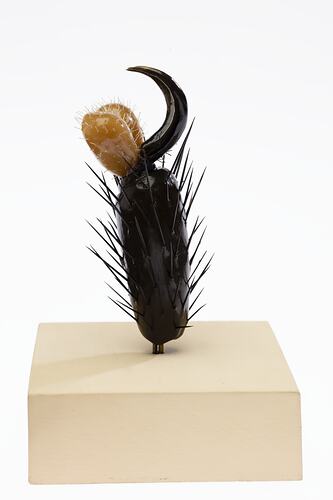
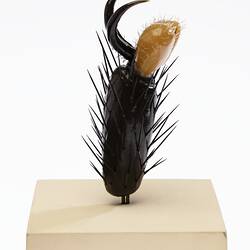
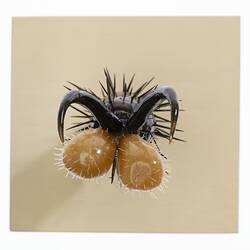
Model of the end of a house fly's leg, 30 times actual size. The model was part of 'The House Fly' exhibit used in the Institute of Applied Science in the 1960s.
The exhibit drew attention to the public health aspects of house flies, noting its role in spreading diseases such as typhoid, tuberculosis, anthrax and cholera. Exhibit signage stated 'No effort should be spared to eradicate this dangerous insect'. Recommended control methods included covering garbage bins and other waste (to prevent egg-laying and larval development), using wire mesh screens and net covers, and the use of insecticides such as pyrethrin and DDT. DDT has since been banned for most agricultural and domestic purposes in a majority of countries worldwide, due to adverse effects on human health and the environment.
Physical Description
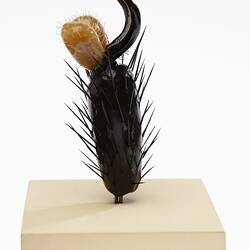
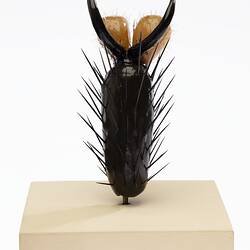
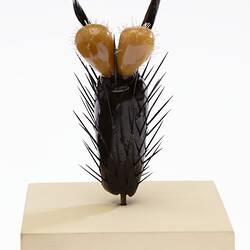
Model of the foot of a house fly standing upright, with prominent hair overall and two yellowish 'pulvilli' (adhesive pads) and a pair of claws at the tip. Displayed on wooden stand painted cream.
More Information
-
Collecting Areas
-
Acquisition Information
Museum generated from Museum of Applied Science of Victoria, Nov 1948
-
Exhibitor
-
Classification
-
Category
-
Discipline
-
Type of item
-
Object Dimensions
50 mm (Width), 50 mm (Depth), 120 mm (Height)
Measurement of model foot only, dimensions of model foot on stand: W: 114mm; H: 160mm; D: 110mm.
-
Keywords
Flies, Healthcare & Medicine, Insect Control, Insects, Pest Control

