Summary
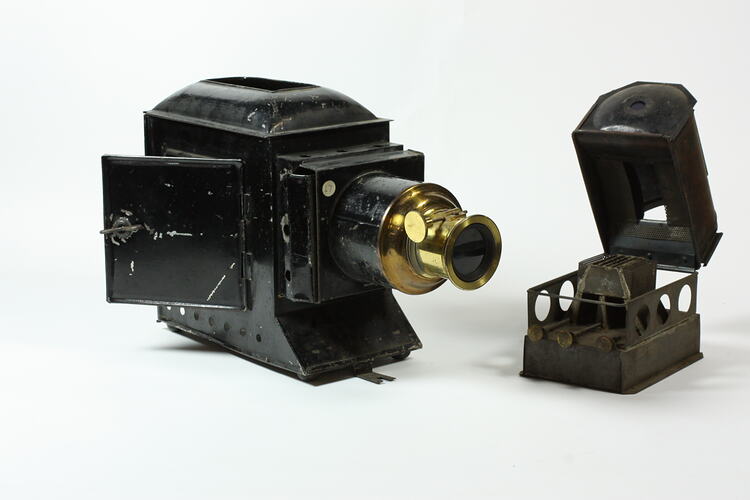
Metal projector was used to view lantern slides. The business of Millikin & Lawley was established initially under the name of John Millikin. The English scientific instrument maker set up in the Strand, London. In 1856 the business became known as John Millikin & Co., with the name changing to Millikin & Co. in 1860. The company sold magic lanterns and slides as part of its business, although it is believed they may have been made elsewhere. They operated until after 1900 at several different locations in the Strand.
While the invention of the magic lantern is generally seen to be in the 17th century, its greatest popularity as an optical projector spans the late 18th century to the early decades of the 20th century. It was used both as a means of entertainment and education.
This lantern projector is part of the Francis Collection of pre-cinematic apparatus and ephemera, acquired by the Australian and Victorian Governments in 1975. David Francis was the curator of the National Film and Sound Archive of the British Film Institute as well as being a co-founder of the Museum of the Moving Image in London, which was operational between 1988 and 1999.
Physical Description
Rectangular japanned metal body. Brass objective tube. Flange at bottom front with slot for fixing lantern onto surface. Ventilation holes (x7) along bottom margin on each lateral side. Further ventilation holes (x3) on each side of square metal outer tube. Rectangular aperture on roof for fixing chimney or cowl. Latched side door on right lateral side of body. Hinged 3/4 flip door on back part of lantern body. Oval brass name plate on back door. Circular aperture in back door above plaque. Japanned metal removable part in slide aperture. This has large cut out circle in centre and semi-circular metal clamps top and bottom. Removable condenser lens. Rectangular slide out 3-wick oil illuminant. Top half of illuminant tilts to allow access to wicks. Circular blue glass viewing hole at back of illuminant.
More Information
-
Collection Names
-
Collecting Areas
-
Acquisition Information
Loan & Subsequent Donation from Australian Film Institute (AFI), Mr David Francis, by Nov 1990
-
Distributor
Millikin & Lawley, 161, 165 & 168 The Strand, London, England, Great Britain, circa 1860-1900
-
Collector
Mr David Francis, London, Middlesex, England, Great Britain, 1990
-
Inscriptions
On oval brass plaque on back door: 'MILLIKIN & LAWLEY/CUTLERS OPTICIANS/& SURGICAL/INSTRUMENT MAKERS/165/STRAND/LONDON' On circular paper sticker on right bottom corner of back door: '457' On circular paper sticker on front of lantern: '17'
-
Classification
-
Category
-
Discipline
-
Type of item
-
Overall Dimensions
420 mm (Length), 140 mm (Width), 260 mm (Height)
-
References
[Book] Robinson, David, et al. 2001. Encyclopaedia of the Magic Lantern., 194 Pages
-
Keywords
Lantern Projectors, Magic Lanterns, Pre-Cinema Moving Images, Projectors