Summary
The original photographs, that the images within the album are based on, were taken at Coranderrk by Fred Kruger, during a number of visits in the 1870s, however the album was compiled and published in Melbourne by Horace Perkins & Co., The Gift Depot, c.1880s. Perkins produced a small number of souvenirs and novelties in the leporello style distributing them from his store The Gift Depot at 51 Bourke Street, Melbourne Vic. He retired and sold the entire contents of his store in Nov 1908.
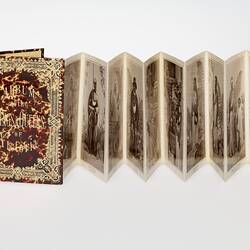
Late Victorian Leporello View Albums contained a series of pictures in book form that could be folded together concertina-like. They generally consisted of a single long page, printed on a single side, folded zigzag fashion (usually referred to as 'accordion pleat') and mounted within ornate gilded card covers. The term Leporello is German in origin meaning 'a fan of folded paper' and was apparently first used in the German music publishing business referring to a folded single sheet. The album is designed to unfold and become a three dimensional gallery.
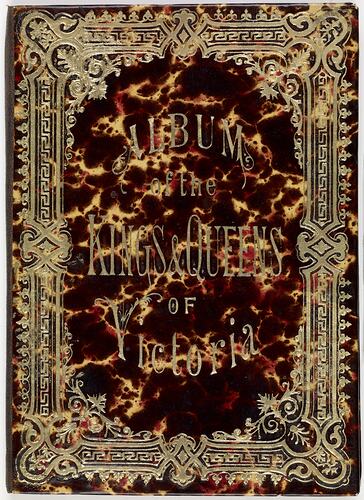
On Front Cover: "Album of the Kings & Queens of Victoria". The titles of the individual images are:
1/ 'King David Warnambool Tribe' 2/ 'Gellibrand Colac Tribe' 3/ 'Queen Mary Ballarat Tribe ' 4/ 'King William Mount Cole Tribe' 5/ 'Queen Eliza Yarra Tribe' 6/ 'King Tom Derrinallum Tribe' 7/ 'Mia Mia and Royal Family' 8/ 'King Billy and His Two Wives' 9/ 'Queen Rose Ballarat Tribe' 10/ 'Tom William Euchuca Tribe' 11/ 'Barker and Son Heron Bacchus Marsh Tribe' 12/ 'Dick Goulbourn Tribe'.
Physical Description
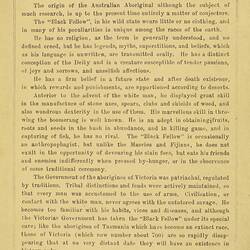
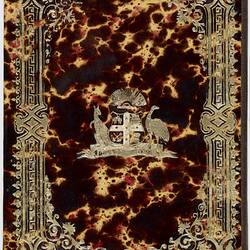
Album, small brown/yellow marbled with elaborate gold patterning around edges and a title in gold lettering entitled 'Album of the Kings & Queens of Victoria.' Undated and no publisher/printer recorded. Identified as a Leporello it contains twelve photographs of stipple engravings of Fred Kruger's portraits joined together in a concertina shaped arrangement with a separate black cover. The images depict Victorian Aboriginal people taken at Coranderrk, in either traditional clothing or European styled clothing; some individuals hold material culture items and two depict people in front of housing. There is a long explanation on the inside back cover of a European viewpoint of Aboriginal culture. The album and images are in excellent condition, except for the worn outside sleeve. The album consists of a single, concertina-folded panel that has been adhered to the front cover only. The panel is printed with etchings in black, red and faun-coloured ink. The printed side of the panel has a coating, which is cracked and yellowed. The panel has shallow cockling throughout. The cover consists of cardboard, covered with tortoiseshell-style cellulosic material (possibly nitrate, possibly paper) and joined at the spine with brown bookcloth. The tortoiseshell covers have gold stamped borders, title (recto) and Australian Coat of Arms (verso). (Conservation description)
More Information
-
Object/Medium
Album
-
Photographer
-
Maker
-
Locality
-
Date Produced
-
Overall Dimensions
100 mm (Length), 140 mm (Width), 5 mm (Height)
Orientation: Portrait (Only two of the images inside are positioned as landscapes]
-
Keywords
People, Clothing, Buildings and Structures, Material Culture
-
Type of item
-
Discipline
-
Category
-
Collecting Areas