Summary
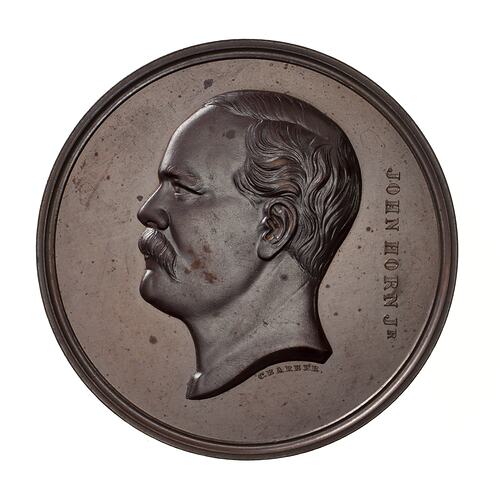
Copper strike of the Congressional Medal awarded to John Horn Jr. for Saving Life, by the United States of America, 1874. John Horn Jr. was born on 7 September 1843 at Sidmouth, Devonshire. The family migrated to the United States of America where his father established a family boat business, running a ferry and two tug-boats, at Detroit. He lived at the docks and between 1863 and 1874 was credited with saving over a hundred people from drowning. During the great fire of Detroit on 11 April 1866 he rescued nine people from the water. In 1869 the citizens of Detroit awarded him a gold medal which was followed in 1874 by a Congressional gold medal.
Since the American Revolution the United States Congress has commissioned gold medals as its highest expression of national appreciation for distinguished achievements and contributions. Each medal honours a particular individual, institution, or event. Often off-metal strikes were later produced for artistic and commemorative purposes.
Obverse Description
Bare head facing left; behind, 'JOHN HORN JR'.
Reverse Description
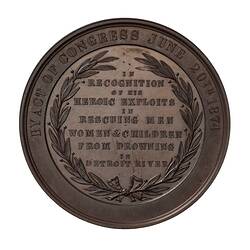
The legend at the centre within an olive wreath, IN / RECOGNITION / OF HIS / HEROIC EXPLOITS / IN / RESCUING MEN / WOMEN & CHILDREN / FROM DROWNING / IN / DETROIT RIVER; around above on broad rim, BY ACT OF CONGRESS JUNE 20TH 1874
Edge Description
The edge is plain
More Information
-
Collecting Areas
-
Acquisition Information
Transfer from National Gallery of Victoria (NGV), 15 Mar 1976
-
Date Issued
1874 AD
-
Issued By
United States of America Congress, United States of America, 1874
-
Person Depicted
-
Series
-
Material
Copper
-
Axis
12
-
Classification
-
Category
-
Discipline
-
Type of item
-
Dimensions
48 mm (Outside Diameter)
-
Shape
Round
-
References
Loubat, J.F. The Medallic History of the United States of America 1776-1876, Washington, 1878, pp. 457-460 (includes a letter from Horn giving details of some of his rescues)
-
Keywords