Summary
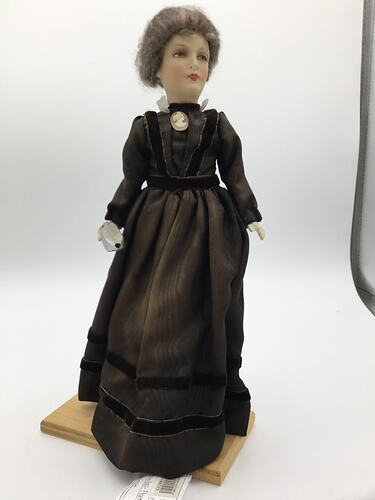
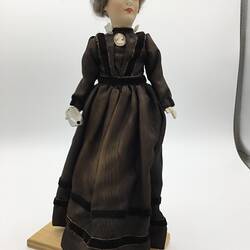
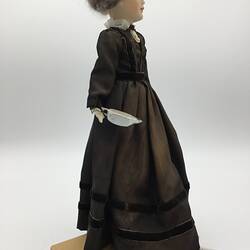
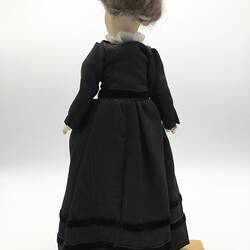
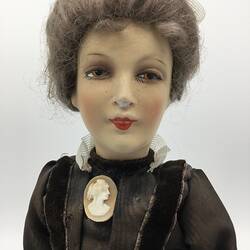
A doll dressed as Florence Nightingale.
The doll was dressed by trainee nurses in the School of Nursing at the Fairfield Infectious Diseases Hospital, before World War II. The doll was part of a display showing 'nursing down the ages', which occupied a glass case in the main room. Some of the dolls were donated to the Hospital by the Matron Gwen Burbidge.
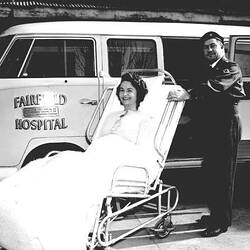
Fairfield Infectious Diseases Hospital began life in 1904 as a fever hospital. It treated Victorian patients for typhoid, diphtheria, cholera, small pox and the epidemics of polio and scarlet fever. It later became one of the world's foremost centres for the research and treatment of infectious diseases, especially HIV/AIDS. It was closed in 1996 amid controversy and protest.
The hospital gained international recognition for its expertise in research and public health. The 'Fairfield culture of care' required dedication to perfecting skills in medicine, nursing, allied health and pastoral care. The Macfarlane Burnet Institute grew out of the virology laboratory established at Fairfield in 1950, where its multidisciplinary approach and active research program led to international renown.
Physical Description
Standing porcelain doll supported by a metal rod on a three-ply wooden board. The doll has grey hair and a painted face, porcelain arms, a padded body and legs, and is missing the left hand. She is dressed in a long black moire taffeta frock trimmed with black velvet. There is a white nylon frill around the neck and pinned on the hair, and a cameo on the bodice. A silver wooden lamp is wired onto the right hand. Underneath the dress are white pants and a lace edged slip. She wears black heeled shoes.
Significance
The objects in the Fairfield Hospital Collection cover the entire period of the hospital's history and represent the areas of nursing, medicine, administration, pharmaceuticals, occupational therapy, infectious disease care and control, disability and mobility aids. Highlights of the collection are:
· Shredder: used to shred hay for making mattresses. Each mattress was burnt after it was used by a patient with infectious disease
· Pedal-powered French jigsaw: used by patients with polio as a form of occupational therapy; carpentry work was conducted whilst strengthening the legs
· Doll collection: approximately 25 dolls and their accessories made by nurses as part of their training at Fairfield; each doll represents one of the nurse archetypes; these are accompanied by an illustration outlining the archetypes eg Sister of Charity, Benedictine monk, Florence Nightingale, a priestess, and an ambulance nurse
· Polio disability aids: callipers and splints for toddlers, children and adults
· Pneumonia jackets: used for babies with pneumonia
· Fumigation bags: used for the fumigation and sterilisation of materials that were in contact with infectious agents
· Blood pump for direct blood transfusion
· Nursing uniforms: covering the period 1910-1980
More Information
-
Collection Names
-
Collecting Areas
-
Acquisition Information
Donation from Fairfield Hospital Archives, Heidelberg Repatriation Hospital, Barbara Rossal-Wynne - Heidelberg Repatriation Hospital, Nov 2008
-
Used By
-
Person Depicted
-
Place Used
-
Place Made
-
Inscriptions
Sole of right shoe- blue and white round label: "MADE IN GERMANY"
-
Classification
-
Category
-
Discipline
-
Type of item
-
Overall Dimensions
160 mm (Width), 87 mm (Depth), 350 mm (Height)
-
References
Anderson, WK, 2002, Fever Hospital: A History of Fairfield Infectious Diseases Hospital, Melbourne University Press
-
Keywords
Hospitals, Infectious Diseases, Nursing, Dolls, Training Aids