Summary
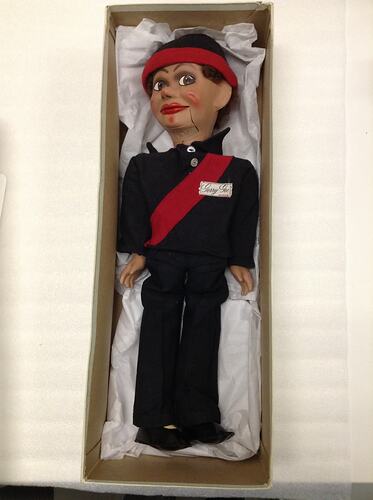
Moulded plaster ventriloquist doll in the form of a boy wearing an Essendon football costume.
This doll was produced by Sterne Doll Company at their factory in Leicester Street, Carlton in the early 1960s. It was produced as part of their toy range based on the ventriloquist doll Gerry Gee, who was featured on Channel Nine's `The Tarax Show'.
Physical Description
Moulded plaster ventriloquist doll in the form of a boy, within green foil covered box with label. L.J. Sterne Gerry Gee Essendon Football Club Supporter Ventriloquist Doll early 1960s, painted composition head with brown mohair wig, painted brown eyes, moveable mouth, wearing black jersey with diagonal red stripe, black pants, yellow socks, black boots, black and red cap and in 'Gerry Gee Junior' box with illustrated label to lift off lid
Significance
The L J Sterne collection is nationally significant as one of the few surviving collections related to an Australian toy and doll manufacturer, a once thriving local industry. Only the Lindsay Archive at the Powerhouse Museum (documenting a children's fancy dress maker of the 1950s - 1980s) and the Jakas collection at Museum Victoria (documenting a soft toy maker of the 1960s - 1990s) are comparable.
A large number of documents, photographs and advertising material, as well as a number of pieces of doll making equipment and parts, were donated to Museum Victoria in the early 1990s. Since then a selection of finished toys have been added to the collection through purchase and donation. These three dolls would be significant additions to the collection, especially as they are rare variations, are in very good condition with boxes present, and two are the rarer Geraldine Gee doll in the `Special' moving glass eyed version.
Lionel Sterne arrived in Melbourne as a refugee from Austria at the outbreak of World War II in 1939. Looking for ways to earn a living, Sterne noticed that there was a shortage of dolls and toys in Melbourne as many of these had previously been imported from Germany and Japan. He began by experimenting in his East Malvern garage with various forms of papier mache to produce dolls heads, and later complete dolls. It was so successful that he soon was running a thriving operation with three other employees.
By 1946 business had expanded to such an extent that a full scale factory was established by Sterne in Leicester Street, Carlton. The Sterne Doll range now included various fashion and bridal dolls, as well as baby dolls and national costume dolls, an expanse enabled by the addition of latex moulding equipment. By 1950, Sterne Dolls had a staff of 30, as well as sales representatives in Sydney, Brisbane, Perth, Adelaide and Hobart.
The next phase of the company's development occurred in 1958 when Sterne was approached by TV ventriloquist Ron Blaskett, who performed on the children's show `The Tarax Club' on GTV Channel 9. He had seen examples of Sterne's work and wanted him to produced replicas of his doll `Gerry Gee' for sale to the public. The `Gerry Gee Junior' doll was born, and can be considered the first real example of Television merchandising in Australia. With continuous daily TV advertising, sales went through the roof, and Sterne had to employ more staff to cope with the demand.
The `Geraldine Gee' doll, Gerry' sister, was added in 1960 to cater for female viewers. Throughout the early and mid 1960s several new styles of `Gerry Gee Juniors' were produced to reflect contemporary fashions - these included the Football Supporter (1961), Cowboy and Cowgirl (reflecting the popularity of American Westerns, in 1963), Beatles Gerry (to coincide with the Beatles tour in 1964) and Space Patrol Gerry and Geraldine (reflecting the interest in Space and Science Fiction in the lead up to the first walk on the moon in 1969.)
Sterne also manufactured soft toys representing other Australian children's television characters, including Humphrey Bear (from `Here's Humphrey) and Fredd and Fifi Bear (from `The Magic Circle Club') Sterne finally retired when he sold the business in 1971. Sterne Dolls seems to have disappeared soon after this, probably a victim of the import tariff reductions introduced by the Whitlam Government in 1973, which saw local markets inundated with cheaper imported goods, particularly from Asia.
More Information
-
Collection Names
-
Collecting Areas
-
Acquisition Information
Purchase
-
Manufacturer
Sterne Doll Company, 121-123 Leicester Street, Carlton, Greater Melbourne, Victoria, Australia, 1960-1962
-
Person Depicted
Gerry Gee, 121-123 Leicester Street, Carlton, Greater Melbourne, Victoria, Australia, 1960-1965
-
Classification
-
Category
-
Discipline
-
Type of item
-
Overall Dimensions
215 mm (Width), 110 mm (Depth), 570 mm (Height)
-
References
M. Fainges, Australian Doll Makers, Australian History, p. 62-72.
-
Keywords
Australian Rules Football, Performers, Television Industry, Television Publicity, Toys, Ventriloquism