Summary
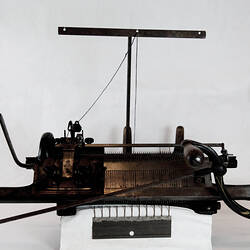
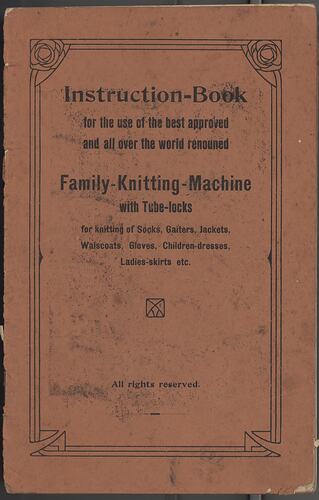
Instruction booklet 'for the use of the best approved and all over the world renowned Family-Knitting-Machine', the tand-powered flat-bed 'Preciosa' knitting machine manufactured by Wertheim (Germany) and retailed in Melbourne by Hugo Wertheim in 1910.
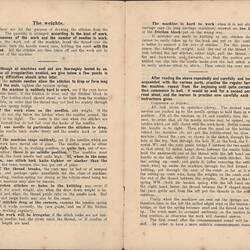
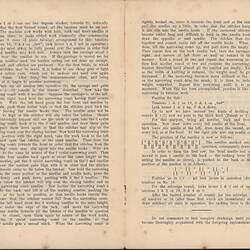
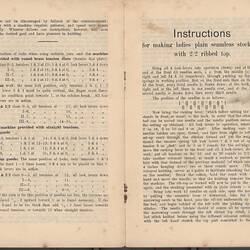
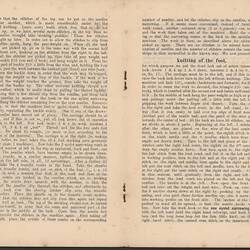
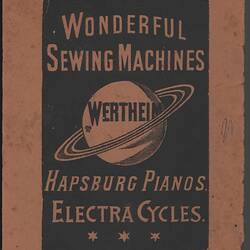
Physical Description
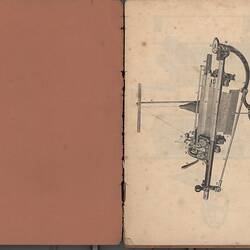
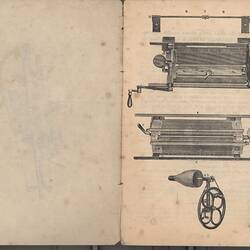
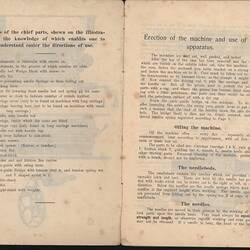
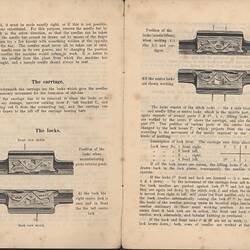
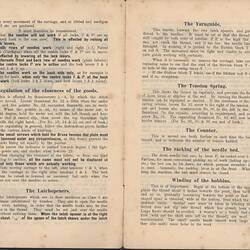
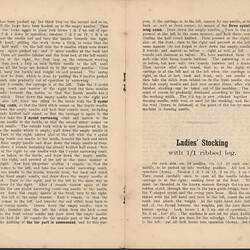
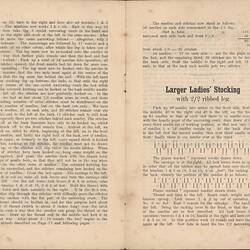
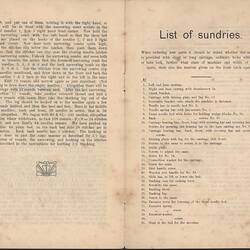
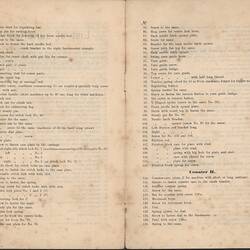
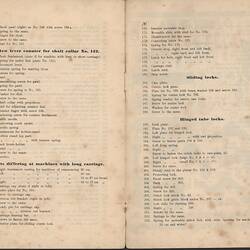
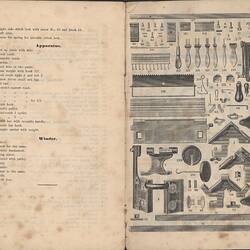
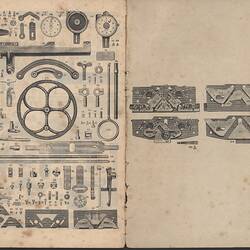
Orange-covered instruction booklet containing 32 pages, stapled at centre. Cover has printed text and line border with floral corner motifs. Back features an advertisement for Wertheim sewing machines and a motif of Saturn with three rings. The booklet provides etched illustrations of the knitting machine and its parts, names the 'chief parts', and lists the 'sundries' - the parts and accessories - of the knitting machine, with numbered images. It provides instruction on the 'Erection of the machine and the use of the apparatus', then provides instructions for making a 'Ladies Stocking' and 'Larger Ladies' Stocking'.
Significance
Statement of Significance:
The knitting machine provides a relatively rare record of a woman's cottage industry in rural Victoria in the early 20th century, as well as being a significant item of material culture relating to work for the war effort on the home front during World Wars I and II. The machine collection includes a range of parts, manuals, users' notes, two garments and a (digital copy of a) photograph of a garment being worn, providing a comprehensive record of how the machine was used and for what purposes, and how this changed over time as a second user worked the machine.
Knitting machines were enthusiastically advertised in the media in the early 20th century when this model was purchased, both for making family clothing and as a means of earning money. Hugo Wertheim advertised knitting machines as 'One of the most profitable means by which to earn a livelihood or supplement an income IN YOUR OWN HOME' (The Age, 4/2/1911, page 2).
The first hand-powered flat-bed knitting machine was invented by the American William Isaac Lamb in 1863. The machine enabled rapid production of tube and rib-knitted fabric. It knitted in alternating plain and pearl stitches, providing a ribbed effect with high elasticity that looked the same on both sides. The year after its invention, Lamb's flat-bed knitting machine was improved by another American, Henry J. Griswold. Sold under the names 'Climax', 'Crane' and 'Little Rapid', the machines were used in the cottage industry to make men's socks and children's stockings. With further improvements in the machine's design, circular-knit stockings could also be made.
In Europe, manufacturer Henri Eduard Dubied saw the flat-bed machine displayed at the World Expo in Paris in 1867. He bought the patent and began to make the machines, which he called the 'Trikoteuse Omnibus', in his own Swiss factory. By the end of the decade French and German manufacturers, including Laue und Timaeus (later Irmscher & Co., Dresden) were also making flat-bed machines. In 1888 the invention of the tubular cam by G. F. Grosser in Markersdorf allowed heels to also be knitted by the flat-bed machines. Later developments facilitated the production of patterned goods and the use of an electric motor.
The Lamb Corporation remains in business to this day.
More Information
-
Collecting Areas
Working Life & Trades, Sustainable Futures, Public Life & Institutions, Clothing & Textiles
-
Acquisition Information
Donation from Raema Edgington
-
Date Purchased
-
Retailer
Hugo Wertheim, 294-296 Bourke Street, Melbourne, Victoria, Australia, 1910
-
Inscriptions
Printed on front: Instruction-Book / for the use of the best approved / and all over the world renouned / Family-Knitting-Machine / with Tube-locks / for knitting of Socks, Gaiters, Jackets, / Waistcoats, Gloves, Children-dresses, / Ladies-skirts etc. / All rights reserved.' Printed on back: 'WONDERFUL / SEWING MACHINES / WERTHEIM / HAPSBURG PIANOS. / ELECTRA CYCLES'. Extensive text within.
-
Classification
-
Category
-
Discipline
-
Type of item
-
References
German Hosiery Museum, [Link 1] accessed 14/6/2012 Wonseok Choi, 'Three Dimensional Seamless Garment Knitting on V-Bed Flat Knitting Machines', Journal of Textile and Apparel, Technology and Management, vol.4, no.3, Spring 2005 Alex L. Askariffm Sewalot web site [Link 2] accessed 15/6/2012 'Hugo Wertheim', Australian Dictionary of Biography, [Link 3] accessed 15/6/2012
-
Keywords
Handcrafts, World War I, 1914-1918, World War II, 1939-1945, Manufacturing, Home Workers, Work in the Home, Knitting Machines, Knitting Patterns, Rural Life, Rural Women, Domestic Work, Soldiers' Comforts