Summary
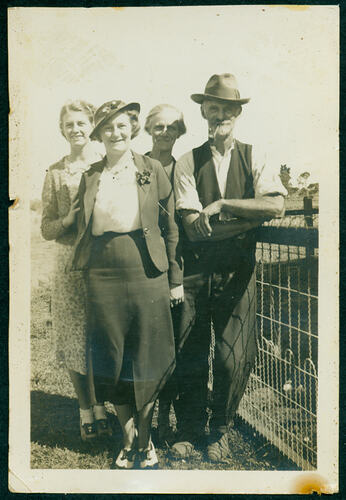
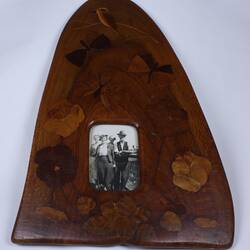
Black and white photograph depicting Edwin Ault and three women, Victoria, 1900-1950. Ault made the parquetry picture frame that originally housed this photograph.
The frame is made from a cross section of Australian native timber, probably Coast Banksia (Banksia intergrifolia) (proteaceae) & inlaid with Fiddleback Blackwood (acacia melanoxylon) (leguminosae), Native Cherry (Exocarpus cupressiformis) (santalaceae).
Edwin Ault was raised in Dromana, Victoria and was a first-generation immigrant from Staffordshire, U.K. Edwin worked as a motor mechanic and also spent a period fixing jetties.
Edwin's love for woodworking was shared by his family. His father, H.W. Ault, possessed a strong interest in wood and plants, and Edwin's brother, Ernest Ault, was a builder, joiner and woodworker. Edwin was keen to share his passion for his craft and would often show family members and friends how to do woodwork. It has been suggested by family members that Edwin's wife made some of the woodwork objects in their home, including, for instance, some breadboards.
In 1912, at age 32, Edwin met and married his wife (Emma Hermine Ault nee Wilhelm). They lived in Lakes Entrance (initially known as Cunningham), where they raised their children. Recurrent motifs in Edwin's work, including, for instance, the greenhood orchid, reflect the indigenous and introduced flora which grew in the locality of his property in Lakes Entrance. Edwin's work, whilst highly decorative in its detailed representation of plants, was also designed to serve functional purposes. Egg cups, carving boards and bookends were used by his family on an everyday basis, and are still remembered fondly by Edwin's grandchildren.
In his work, Edwin favoured a free-form approach. He respected the original form of the wood and would shape it according to its natural pattern and form. It is believed that some of his pieces, including, for instance, one of his picture frames, are made of driftwood. Edwin would air-dry his wood, or sometimes season it by placing it in crayfish pots, and steeping it in river and sea water. Significantly, Edwin's work utilises functional elements such as bolts and screws, reflecting his background in engineering. Edwin's work, with its intricate depictions of indigenous Australian and introduced plants, and its highly functional elements drawn from engineering practice, can provide valuable insight into the Australian Arts and Crafts movement and the lifestyle of Victorian families of the time.
Description of Content
Edwin Ault standing with three women outdoors. He has a pipe in his mouth and leans on a metal and wood garden fence.
More Information
-
Collecting Areas
-
Acquisition Information
Donation from Ms Helen Hallett, Dec 1980
-
Maker
Edwin Ault, Victoria, Australia, 1900-1950
Maker of frame photograph was originally housed in. -
Individuals Identified
Ault, Edwin
-
Format
Photograph, paper base, Silver gelatin print, Sepia
-
Classification
-
Category
-
Discipline
-
Type of item
-
Keywords