Summary
Tjampawa Stevens is a Pitjantjatjara artist who was born in the Western Desert at Areyonga in the Northern Territory around 1947. She later moved to Nyapari homelands with her husband, Keith Stevens, and their five children to look after the Country of their Ancestors. Nyapari is located in South Australia, just south of the Northern Territory border, and is part of the Anangu Pitjantjatjara Yankunytjatjara (APY) lands.
Tjampawa is the coordinator of the craft room she established at Nyapari, where the women in the community come to create works of art together. The women's works are sold in Alice Springs through the women's council.
As well as being a highly skilled punu (carving) artist, Tjampawa is an accomplished painter and has been included in many prominent exhibitions throughout Australia. Tjampawa is also known for her weaving skills, making baskets and sculptures from from tjanpi (grass) and raffia.
Local Name
Nganamara
Physical Description
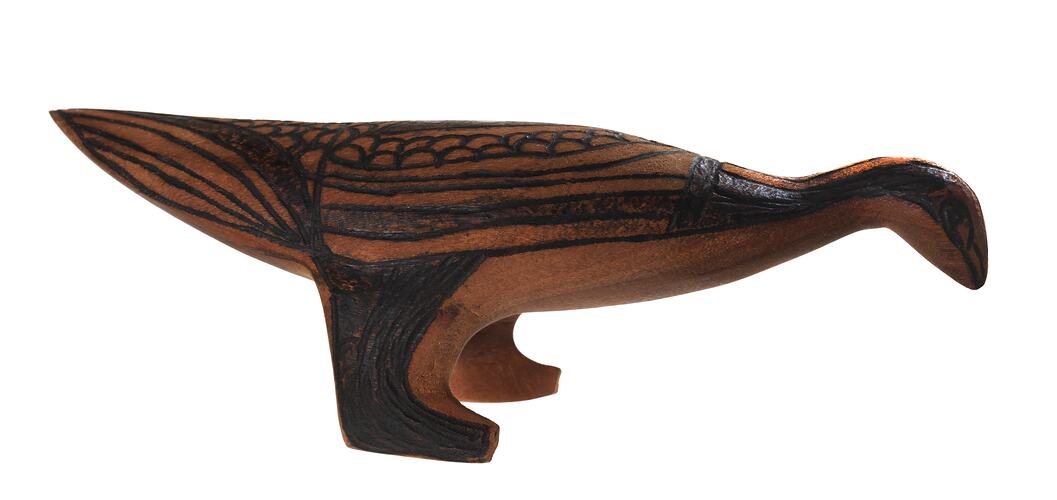
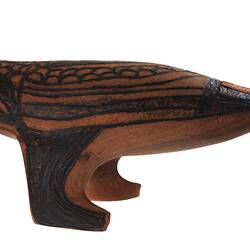
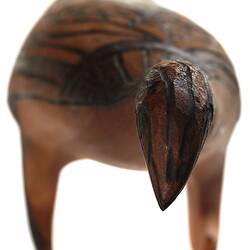
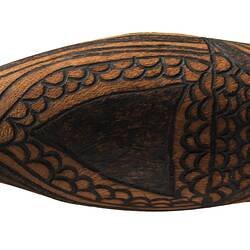
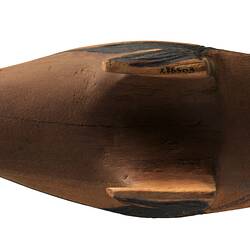
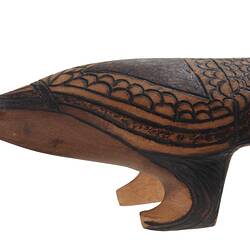
Carved wooden bird which sits horizontally on two legs underneath at each side of bird. Decorated with pokerwork designs on upper surfaces and legs. The design consists of a solid triangle at centre of back which is surrounded by arcs with lines along sides and neck of bird. Eyes, beak, and legs have solid pokerwork decoration.
Significance
Nganamara (malleefowl) depicted in this punu (carving) are large ground-dwelling birds with mottled feathers that build great mounds in which to lay their eggs. The male birds are only slightly larger than females, but expert Pitjantjatjara trackers are able to tell the sex of the bird from its tjina (tracks). Nganamara live in minyura (mulga) woodlands and are classified 'vulnerable' in South Australia. A decline in Aboriginal land-management practices due to the displacement of traditional owners, and a lack of respect for their continuous occupation and incomparable knowledge of these lands, has played a significant role in the disappearance of Nganamara from Central Australia.
APY Land Management is working with traditional owners on a Nganamara monitoring project. This includes conducting protective patch burns around their habitat, monitoring mound activity and recording traditional knowledge about the birds.
More Information
-
Object/Medium
Animal figure
-
Maker
-
Cultural Groups
-
Locality
Nyapari Homelands, Desert Central, South Australia, Australia
-
Date Produced
-
Collector
-
Date Collected
-
Object Measurements
340 mm (Length), 140 mm (Width), 125 mm (Height), 700 g (Weight)
-
Classification
-
Date Made
-
Maker
-
Clan/Language Group
-
Place Made
-
Indigenous Region
-
Keywords
-
Type of item
-
Discipline
-
Category
-
Collecting Areas