Summary
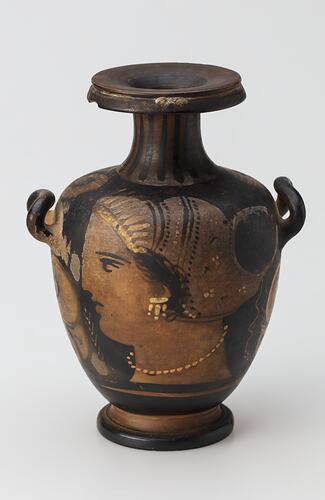
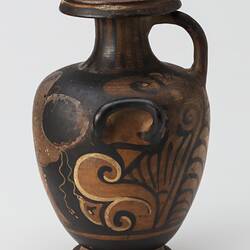
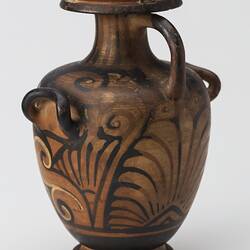
This red-figured hydria is thought to have been made in Cumae, Italy, between around 330 BCE and 320 BCE based on its style. This was a time when the rising Roman Republic flexed its might against neighbours such as the Samnites and Etruscans. The hydria was a vessel type used for water. The red-figured style was developed in ancient Greece and then taken up by makers based in what is today Italy.
Our museum undertakes research with legacy collections from around the world to better understand the provenance of objects - who made them, where, and the paths travelled to arrive here. This hydria came to our collection in 1990 from the estate of Nicholas Hayes Dashwood, a high-born Englishman who lived in Melbourne's East. It is not yet known how he obtained this and a companion piece (X 88719).
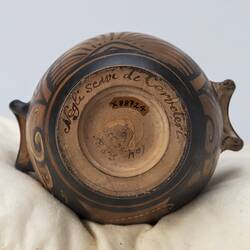
An inscription on the base of this hydria says "Negli scavi de Cerveteri", meaning "in the excavations of Cerveteri". Once a stronghold of the Etruscans, the town of Cerveteri is located north of Rome and is a site of global heritage significance. The differing provenance clues could be explained by the possibility that the hydria was made in Cumae, near present-day Naples, and traded north.
Selected sources
'Cumae', Britannica online, https://www.britannica.com/place/Cumae, accessed 21 January 2026.
AB Trendall, 'The Red-Figured Vases of Lucania, Campania and Sicily (Oxford: At the Clarendon Press, 1967).
Physical Description
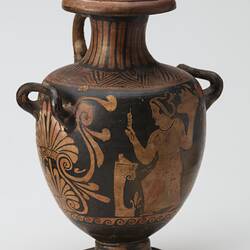
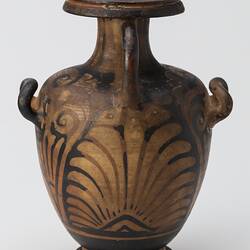
A red-figured hydria (water vessel) with three handles, two placed on the body of the vessel and one on the neck. The main image depicts the face of a richly adorned woman in profile. Other decorative elements include scrolls, palmettes and a fan.
More Information
-
Object/Medium
Pottery
-
Locality
-
Date Produced
-
Object Measurements
120 mm (Length), 120 mm (Width), 173 mm (Height), 120 mm (Outside Diameter)
-
Keywords
-
Type of item
-
Discipline
-
Category
-
Collecting Areas