Summary
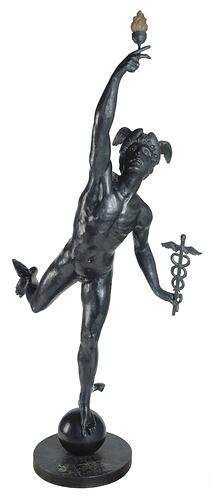
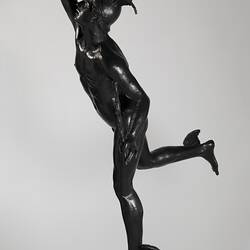
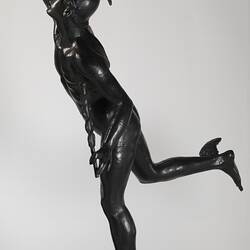
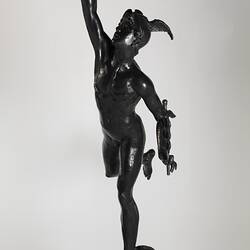
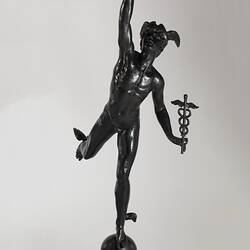
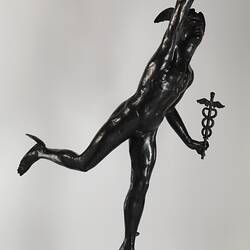
Statue titled 'Mercury' modelled by C. Douglas Richardson and fabricated by W.H. Rocke & Co in 1899. It was comissioned by David Syme, the proprietor of The Age newspaper, and stood atop the Age building at 233 Collins Street, Melbourne from 1899-1969. In 1969 it was moved to the Age building on Spencer Street first standing on a platform on the corner of Spencer and Lonsdale Streets and then on the Spencer Street verandah. The statue did not appear to best advantage in either location, and was placed in storage. In 1985 it was lent to the Museum of Victoria for the Story of Victoria exhibition, and was then donated to the Museum by David Syme & Co. Ltd in 1997.
The statue was created by the sculptor and painter Charles Douglas Richardson, who was inspired by Giambologna's bronze statue, made in Florence in 1580. It was made of 20 pieces of beaten copper which were riveted together and cast by W.H. Rocke of Melbourne.
Mercury fascinated the citizens of Melbourne when he first appeared on top of the newly renovated Age building in Collins Street, Melbourne, in August 1899. Many were alarmed at the prospect of the first blustery north wind dislodging the statue. The Age assured them that Mercury would not make a sudden descent into Collins Street, as he had a 3-inch steel tube passing from the shoulder, through the body and leg, and embedded nine feet into a stone block in the wall.
Mercury, the Roman messenger god, symbolised the newspaper's role in communication.
Physical Description
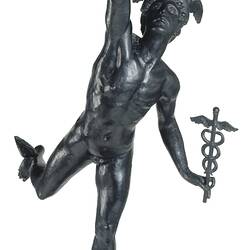
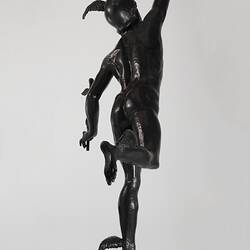
Statue aproximately four metres high, depicting the figure of the Roman god Mercury with winged hat and feet, standing on top of an orb (representing the world), holding a Caduceus and a glass lamp aloft. It is made of copper on a steel frame. Running down from the lamp, inside the statue is an electrical cable, the end of which can be seen beneath the standing foot. The wires are old and no longer functioning. The lamp appears to be held in place by means of four equidistant brass screws and some kind of flexible sealant. The size of the lamp and the sealant indicates the glass is not original. Old brown glass found inside one of the feet is probably the original glass and further attests to the lamps replacement.The statue attaches to a separately cast metal plinth with an orb. The two pieces (statue and plinth) are secured together via a steel rod passing from the shoulder, through the body and leg and fixed to the interior of the orb with coach bolts. A plaque is attached to the top face of the plinth.
More Information
-
Collecting Areas
-
Acquisition Information
Donation from David Syme & Co. Ltd., 14 Apr 1997
-
Commissioned By
David Syme & Co., Melbourne, Victoria, Australia, circa 1899
-
Artist
Mr Charles Douglas Richardson, Collins Street, Melbourne, Greater Melbourne, Victoria, Australia, circa 1899
-
Creator
W.H. Rocke & Co., Melbourne, Greater Melbourne, Victoria, Australia, 1899
Fabricated by W. H. Rocke & Co from the model made by C. D. Richardson -
Deity Depicted
-
Place & Date Exhibited
The Age Office, 233 Collins Street, Melbourne, Greater Melbourne, Victoria, Australia, 1899-1969
-
Place & Date Exhibited
Museum of Victoria, Melbourne, Victoria, Australia, 1985-1992
Displayed in the Story of Victoria Exhibition -
Inscriptions
Plaque is attached to the top face of the plinth: ;Mercury fascinated the citizens of Melbourne when he first appeared on top of the newly renovated Age building in Collins Street, Melbourne, in August 1899. Many were alarmed at the prospect of the first blustery north wind dislodging the statue. The Age assured them that Mercury would not make a sudden descent into Collins Street, as he had a 3-inch steel tube passing from the shoulder, through the body and leg, and embedded nine feet into a stone block in the wall'.
-
Brand Names
-
Classification
-
Category
-
Discipline
-
Type of item
-
overall dimensions
1850 mm (Length), 1000 mm (Width), 3480 mm (Height)
Metal Base: 87.00 circ. x 60.00 high. Wood Base: 100.00 width x 36.00d. Weight: Statue - 90 Kilos. Base: 50 Kilos. Total Weight: 140 Kilograms.
-
Exhibition Collection Management
3830 mm (Height), 140 (Weight)
diameter of base 905mm; height of base 100mm
-
Dimensions
1850 mm (Width), 3860 mm (Height)
Measurement From Conservation.
-
Keywords
Sculpture, Artistic Practices, Art, Artists, Public Art, Newspapers