
Summary
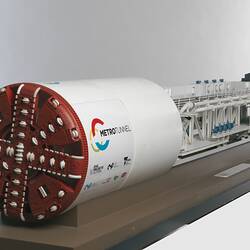
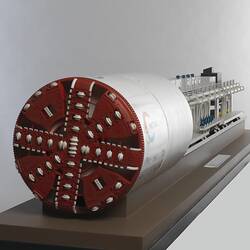
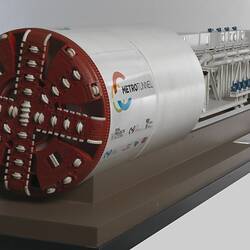
The model, which is 33 times smaller than the real full size tunnel boring machine (TBM), represents one of four 7.28m diameter Herrenknecht Mixshield Tunnel Boring Machines used on the Metro Tunnel project. It represents TBM Joan, with a red-coloured cutter head, which was named after Joan Kirner, Victoria's first female Premier. Each of the four tunnel boring machines were given names (and unique colours for the cutting heads) which resulted from a public competition to honour Victoria's ground-breaking women, and included Meg Lanning (Australian women's cricket team captain - blue), Alice Appleford (wartime nurse - green), and Millie Peacock (Victoria's first female MP - yellow). Tunnel boring machines are given female names in a tradition that began in the 1500s when miners and military tunnellers prayed to their patron saint, Saint Barbara, to keep them safe while undertaking their often dangerous underground operations.
The model was commissioned by Cross Yarra Partnership (CYP) consortium (Lendlease Melbourne Metro, John Holland, Bouygues Construction, John Laing and Capella Capital ) who were awarded the contract for the construction of the tunnels and new stations for the Rail Projects Victoria "Metro Tunnel Project". The model was used by Rail Projects Victoria as part of their project education and communication hub "Metro Tunnel HQ" near the Metro Tunnel City Square construction site (opposite Melbourne Town Hall). From November 2018 to March 2020, the hub, with its interactives and interpretative displays, demonstrated to visitors how the new underground rail system would be built.
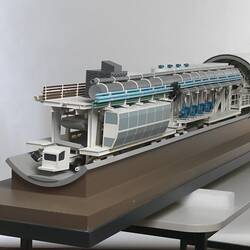
The model was custom-built by Melbourne modelmaker Mark O'Brien (Benchmark Model Making) and completed in 2018. He used a combination of modern and traditional techniques, generating a three-dimensional (3D) computer model which he uses to 3D print some components, as well as using acrylic and moulded resin techniques for detailing. It was designed with internal LED lights, and the cutterhead could be rotated by pressing a button.
TBM Joan began to be assembled at the North Melbourne tunnel construction site in June 2019, almost a year after the ground had first been broken up to create the shaft (station box) into which sections of the machine would be subsequently lowered and connected together, piece by piece. By August 2019, TBM Joan had begun its journey from North Melbourne towards Kensington, digging for 24 hours a day, advancing at a rate of around 10 metres a day, 7 days a week. A crew of up to 10 workers were present in the machine, to operate and monitor its progress. TBM Joan broke through into the new Arden Station's western tunnel entrance in Kensington in February 2020, completing the first section of the project. Along its 1.2 km journey TBM Joan installed 4,200 curved concrete segments (made at a concrete manufacturing plant in Deer Park) to create 700 rings to line the walls of the tunnel.
Physical Description
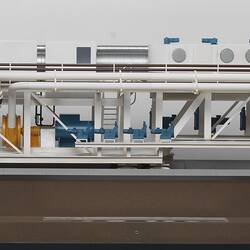
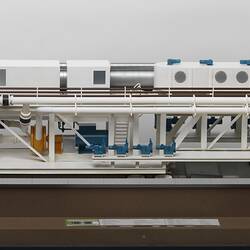
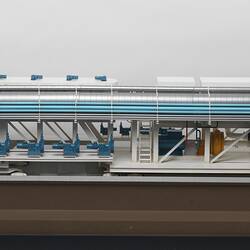
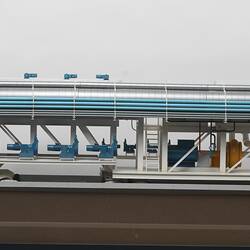
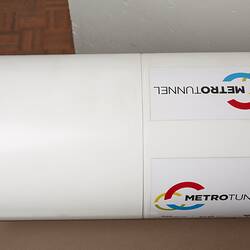
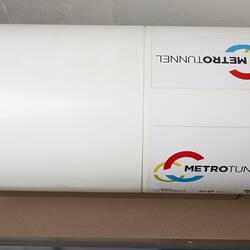
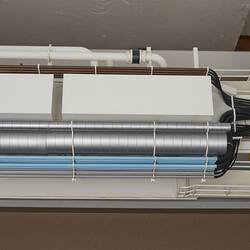
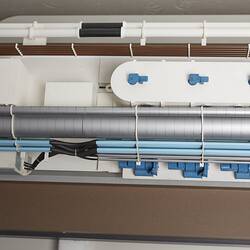
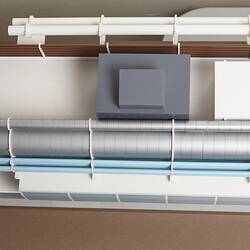
Cylindrical white plastic model with red plastic cutter head. The last three-quarters of the model has been sectioned to show the machinery inside. The model is attached to a light brown base and has an acrylic lid. A paper label is attached to the base. A black plastic power cord and plug is attached underneath the cutterhead end for internal lighting. There is also wiring for the addition of a pushbutton [not in situ] to operate the cutterhead.
Significance
The model represents one of the types of machines used for the construction of Victoria's largest metro rail infrastructure project since the original Underground Metro Rail project of the 1970s-1980s. The Metro Tunnel project commenced construction in 2017 to deliver a new underground rail system of two tunnels and five new stations, and open to commuters by 2025.
Herrenknecht, Germany's largest TBM manufacturer, built six of the tunnel boring machines used for Victoria's Metro Rail project (four TBMs) and the West Gate Tunnel project (two TBMs). The TBMs used for the Metro Tunnel Project weighed more than 1,100 tonnes, had cutting heads of 7.28 metres diameter, and an overall length of 120 metres. They were used to create two 9km train tunnels under the Melbourne CBD to connect the western suburbs to the south-eastern suburbs. The same type of boring machine (but with a much smaller cutting head diameter) has also been used as part of Melbourne Water's water and sewerage system upgrades, including the Hobsons Bay Main upgrade project undertaken on the Scienceworks museum site.
More Information
-
Collecting Areas
-
Maker
Mark O'Brien - Benchmark Modelmaking, Melbourne, Greater Melbourne, Victoria, Australia, 2018
-
Used By
Metro Tunnel Project, Rail Projects Victoria, Melbourne, Victoria, Australia, 2018-2020
-
Person Named
-
Inscriptions
On model: [Logo] METRO TUNNEL / [Logos for Rail Projects Victoria, Cross Yarra Partnership, and Victorian State Government] / [Logos for CYD Design & Construction, John Holland, Lendlease, and Bouygues Construction] On label: HERRENKNECHT / Tunnelvortriebstechnik / [Statistics of full scale tunnel boring machine]
-
Classification
Building & construction, Construction & earthmoving equipment
-
Category
-
Discipline
-
Type of item
-
Object Dimensions
2435 mm (Length), 363 mm (Outside Diameter)
Dimensions of model only.
-
Case Dimensions
2704 mm (Length), 457 mm (Width), 527 mm (Height)
Width dimensions do not include the screw caps on the longer sides which protrude and extra 1-2mm on each side.
-
Model Scale
1:33
-
Keywords
Modelmaking, Models & Modelmaking, Tunnelling, Infrastructure