Summary
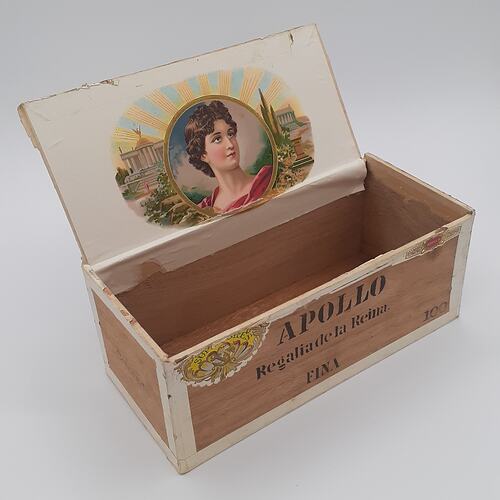
Lidded cigar box made of wood with multiple paper labels on all sides used at Museum of Victoria, 1950-2000.
This object forms part of a small collection of items used in the collection management of the Entomology Collection at Museums Victoria during the twentieth century.
Physical Description
Rectangular wooden box with a hinged lid with a spherical logo of a resting, crowned lion with a shield and a sword stamped in black ink in the middle of the lid and three coloured, paper labels of images and text affixed to the box, two of which are extended over two adjacent sides and torn at the junction. The box edges are wrapped with white paper tape and it has text stamped in black ink on three of its faces. On the inside face of the lid there is a white paper label with a centrally-printed image inside a gold-coloured circular frame of the turned head and shoulders of a young woman with short, dark brown hair and wearing a red dress. To each side of the frame there is a view of a Classical temple in the landscape and yellow slanted rays of the sun in a blue sky emanating from the top of the frame. The same image of the young woman is shown on one of the side labels and another has a heraldic design above text and an anchor. There is handrwitten text in blue pencil on the lid of the box. The box is empty.
Significance
This collection of office, stationary and storage supplies from the Entomology Department of Museums Victoria captures the manual, paper based approach to collection management in the twentieth century. It includes all manner of labelling including inked stamps, specimen labels for transporting and exchange and the very small square 'National Museum of Victoria' labels which were adhered to all mounted specimens when the Natural Sciences were a distinct and seperate institution. Particularly interesting objects such at the First Aid book reveal the approach to collections hazards and OHS before either of those things became a focus of process. And a series of cigar boxes and medicine conatiners reveal the make-do approach to transporting collection specimens in the period before standarizard storage. Overall this small collection is a significant contribution to the history of the museum, documenting the very practical work behind the scences, caring for the collections.
More Information
-
Collection Names
-
Collecting Areas
-
Used By
-
Inscriptions
Stamped on the lid in the logo: 'APOLLO' . Affixed paper label on lid: 'APOLLO'. Handwriting on lid : 'Box No 5 [crossed through] / Box No 13' Stamped on one long side: 'APOLLO / Regaliade la Reina. / FINA / 100' Stamped on one end: 'Colorado'. Stamped on the bottom: [in a diamond border] '8/?'
-
Classification
-
Category
-
Discipline
-
Type of item
-
Object Dimensions
260 mm (Length), 118 mm (Width), 102 mm (Height)
-
Keywords
Museum History, Museum Displays, Museum Victoria, Museums, Museum Storage, Museum Industry, Cigar Boxes