Summary
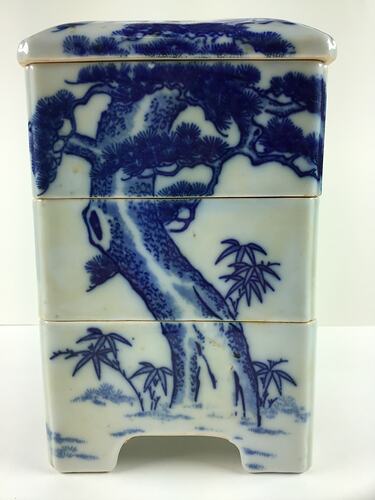
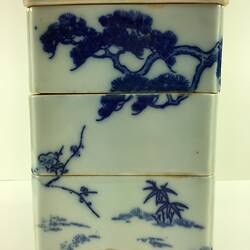
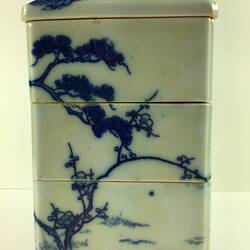
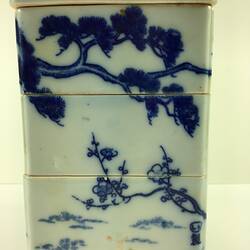
Jubako (in Japanese language 'bako' meaning 'box'), a three-tiered, vertical ceramic food server used for serving food at traditional Japanese family celebrations. The family cannot recall this jubako being used at their dining table at 21 Little Ryrie Street Geelong, but certainly displayed there, likely from the 1940s.
According to the family, a variety of food was served over several days on occasions such as New Year, and is a tangible demonstration that Setsutaro Hasegawa was maintaining traditional Japanese domestic practices. The separate containers contained such cooked foods as sweetened black beans, seaweed, fish, prawns and eggs. The jubako was passed down to the donor, one of Setsutaro's grandchildren, who was born in 1943, lived at the family home and remembers her grandfather Setsutaro well. It probably remained in the home until 1971 while occupied by the Hasegawa family.
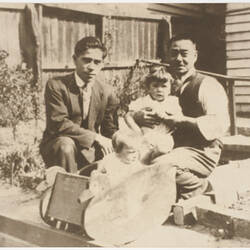
Setsutaro migrated to Australia from Japan in 1897 at the age of 26, just four years before the introduction of the Immigration Restriction Act which severely limited migration to Australia from countries in Asia. He established a laundry business in Geelong and by 1911 he had married an Australian-born woman and had three children.
In 1941 Setsutaro was arrested as an enemy alien and sent to Tatura internment camp in northern Victoria. Released early in 1943 due to his age and poor health, unlike most Japanese interns he was not deported to Japan after the War. Setsutaro remained in Geelong for the rest of his life and died in 1952.
Physical Description
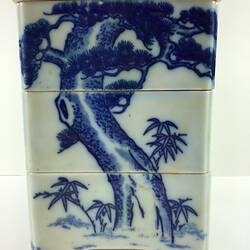
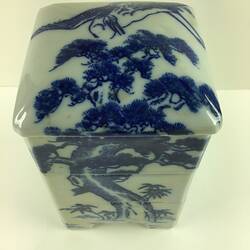
Three-tiered, vertical white ceramic food server with blue tree decoration which create one image when matched up. There is a lid and the bottom tier has four feet.
Significance
The Hasegawa collection enables the exploration of a number of important historical themes relating to migration, working life, and wartime internment in Victoria. Late nineteenth century and early to mid twentieth century Japanese migration and settlement experiences are little represented in the museum's collections and this collection of clothing, documents, personal items and photographs helps to redress.
More Information
-
Collecting Areas
-
Original Owner
-
Classification
-
Category
-
Discipline
-
Type of item
-
Object Dimensions
126 mm (Width), 220 mm (Height)
126 lid width; rest of item 122w
-
Keywords
Japanese Culture, Japanese Immigration, Japanese Communities, Food & Drink Consumption, Food Containers, Food Presentation, Ceramics