Summary
Alternative Name(s): Hopscotch Marker
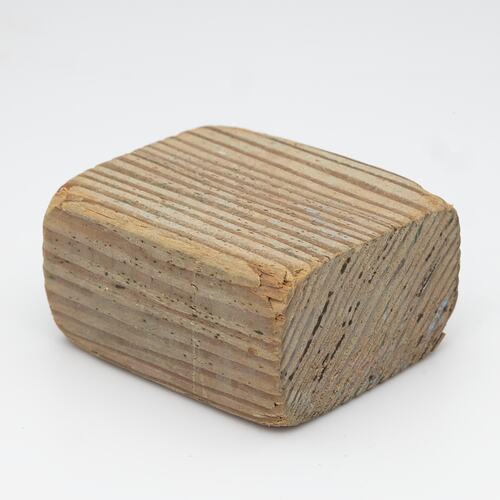
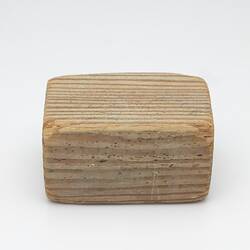
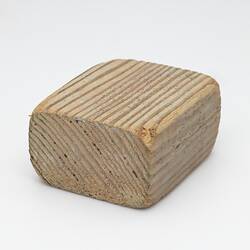
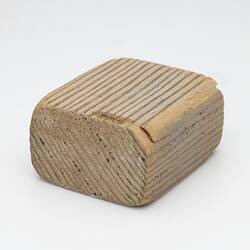
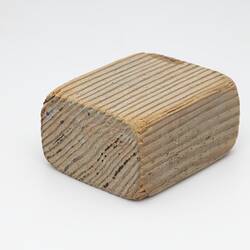
Wooden block hopscotch marker. One of five hopscotch taws, collected for the Children's Museum's 'You're IT!' exhibition held in Melbourne in 1988. A note with the acquisition refers to them as 'recreations', suggesting they were not actually used for hopscotch but are representative of what might have been used.
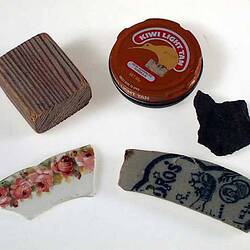
Hopscotch is played, with many variations, in countries all around the world. 'Scotch' is an old English word meaning to mark or score lightly, and drawing the playing grid in chalk, with a stone or with the toe of a shoe in the dirt, is generally the first stage of the game. Hopscotch diagrams have been found in the ruins of the Forum in Rome and in Pompeii. It is thought that hopping through the grid symbolised a journey - from life to death; from Heaven to Hell; or through the signs of the Zodiac. Hopscotch markers, or taws, are generally gathered from materials at hand and may be stones or rocks, empty tins filled with sand or broken crockery. These taws are typical of those used by children in Australian playgrounds and homes across generations.
Part of the Australian Children's Folklore Collection, unique in Australia, documenting contemporary children's folklore across Australia and in other countries reaching back to the 1870s. The Collection has a strong component of research material relating to Victoria.
Physical Description
Square block of pale wood with heavy wood grain markings.
Significance
See Parent Record
More Information
-
Collection Names
-
Collecting Areas
-
Acquisition Information
Cultural Gifts Donation from Dr June Factor, 18 May 1999
-
Acknowledgement
Donated through the Australian Government's Cultural Gifts Program.
-
Classification
-
Category
-
Discipline
-
Type of item
-
Overall Dimensions
50 mm (Width), 60 mm (Depth), 30 mm (Height)
-
References
See Parent Record
-
Keywords
Children's Folklore, Children's Play, Games, Making Do, Recreation