Summary
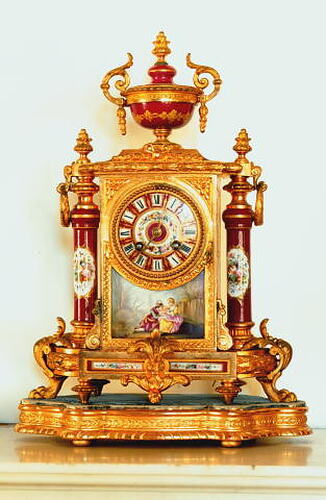
An ormolu garniture comprising a three-piece clock ensemble, made in France, circa 1880s. The set consists of a mantel clock and two matching side pieces. The clock features a 15-day striker movement.
A garniture typically consists of an ornately decorated ormolu (gilt bronze) mantel clock with a complementary pair of either vases or candelabra.
The term 'ormolu' comes from the French words 'or', meaning 'gold', and 'moulu', meaning 'ground'. Its distinctive and durable finish was achieved through a process in which finely ground gold was amalgamated with mercury and applied to a bronze surface. It was then heated to evaporate the mercury, resulting in a lustrous gold surface. This process produced a highly desired outcome but posed significant health risks to the workers involved due to toxic mercury exposure. As a result, the practice declined and was largely discontinued by the 19th century.
Physical Description
Garniture comprising a highly ornate mantel clock and two matching capped vases. Clock has gilt metal frame with decorative pink enamel columns at side and urn on top surrounding a pictorial inset and decorated face with gilt foliage ornamentation. Clock and side pieces stand on individual wooden bases and were originally under glass domes. Spring wound; anchor escapement.
More Information
-
Collecting Areas
-
Acquisition Information
Donation from Miss M. Train, 23 Jul 1976
-
Place & Date Made
-
Inscriptions
No. on movement is 2579. Pendulum no. 3154.
-
Classification
-
Category
-
Discipline
-
Type of item
-
Overall Dimensions
10 cm (Length), 26 cm (Width), 38 cm (Height)
-
Keywords