

Summary
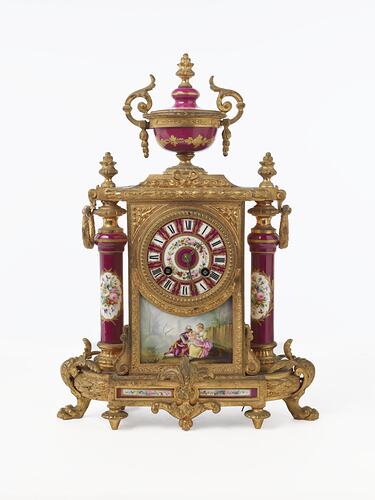
Mantel clock that is part of a ormolu garniture, made in France, circa 1880s. The set consists of a mantel clock and two matching side pieces. The clock features a 15-day striker movement.
A garniture typically consists of an ornately decorated ormolu (gilt bronze) mantel clock with a complementary pair of either vases or candelabra.
The term 'ormolu' comes from the French words 'or', meaning 'gold', and 'moulu', meaning 'ground'. Its distinctive and durable finish was achieved through a process in which finely ground gold was amalgamated with mercury and applied to a bronze surface. It was then heated to evaporate the mercury, resulting in a lustrous gold surface. This process produced a highly desired outcome but posed significant health risks to the workers involved due to toxic mercury exposure. As a result, the practice declined and was largely discontinued by the 19th century.
Physical Description
Highly ornate mantel clock. Gilt metal frame with decorative pink enamel columns at side and urn on top surrounding a pictorial inset and decorated face with gilt foliage ornamentation. Clock stands on a wooden base. Spring wound; anchor escapement.
More Information
-
Collecting Areas
-
Acquisition Information
Donation from Miss M. Train, 23 Jul 1976
-
Place & Date Made
-
Inscriptions
No. on movement is 2579. Pendulum no. 3154.
-
Classification
-
Category
-
Discipline
-
Type of item
-
Dimensions
10 (Length), 26 (Width), 38 (Height)
-
Keywords