Summary
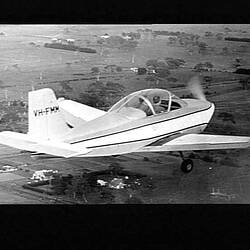
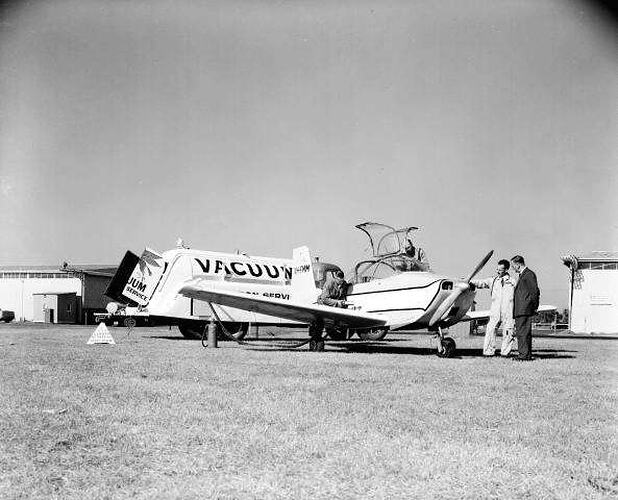
Airtourer Prototype (Mk 1). Country: Australia. Maker & Date: Ultra Light Aircraft Association of Australia, 1959. Designed by a design team led by Henry K. Millicer. Type: monoplane. Two seat single engine cantilever low wing monoplane of wooden construction. Propulsion: Continental A-65 (missing). Paintwork is yellow and white with black lining. Ten piece Perspex canopy fitted. Civil registration marking on tail "VH- FMM".
The original Airtourer design was developed by H.K. (Henry) Millicer, G.D. Bennett and J.M. Tutty in 1952 as an entry in a competition run by the Royal Aero Club (UK), seeking designs for low-cost aircraft suitable for use by aero clubs in three categories: 1) two-seat light touring aircraft; 2) single-seat racing aircraft; and 3) single-seat aerobatic aircraft. The first prototype was built by the Air Tourer Group within the Victorian Division of the Ultra Light Aircraft Association of Australia at the premises of Perfectus Airscrews, Melbourne, using components supplied by Perfectus, the Commonwealth Aircraft Corporation (C.A.C.), Government Aircraft Factory (G.A.F.) and East-West Airlines, at a cost of about £4,500. Final assembly took place in a garage at Williamstown, Victoria in January 1959. The prototype was first test flown on 30 March 1959 at Moorabbin Airport, Victoria, under civilian registration "VH-FMM", by Randall Green. £1,000 towards the development costs were provided by the Aero Club Federation of Australia as the type was seen as a potential club trainer. East-West Airlines were initially interested in manufacturing the aircraft but did not follow through on the proposal. The design was later further developed into the all-metal Victa Airtourer, with 169 aircraft being produced commercially by Victa Consolidated Industries Ltd (manufacturers of the Victa lawn mower) between 1961 and 1966, making it one of Australia's most successful civilian aircraft designs.
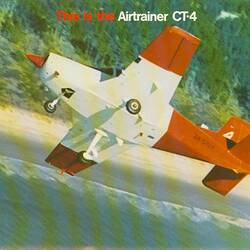
International manufacturing rights to the Airtourer were subsequently purchased by Aero Engine Services Ltd (AESL) of New Zealand who continued to manufacture and market the aircraft with considerable success until 1980. Ironically, one of their largest orders came from the Royal Australian Air Force (RAAF), which purchased fifty-one CT4A Airtrainers, based on the Aircruiser (an up-rated four-seat version of the Airtourer) between 1975 and 1982. They remained in service as a RAAF's basic trainer until as late as 2004.
The Museum received the wooden prototype VH-FMM as a donation in 1977.
Physical Description
Aircraft comprising a fuselage, wings, instrument panel, a number of aeronautical instrucments, and miscellaneous parts such as small metal panels, screws and bolts. The engine was not present on acquisition. Some asbestos rope was removed from the firewall in 1991. The aircraft is constructed primarily from fibreglass, timber and fabric with a 10 piece Perspex canopy. Other components are made of ferrous metal and other alloys, rubber, vinyl, plastic, glass, paint and paper. The plane is painted yellow and white with black lining and lettering. The aircraft is stored partially dismantled - the wings, two yellow painted fairings (front wheel cover), a grey painted wooden propeller and fibreglass nose cone have been removed. The fuselage is supported by a yellow painted steel frame.
More Information
-
Collecting Areas
-
Acquisition Information
Donation from D. P. Kelly, 01 Aug 1977
-
Manufacturer
Ultra Light Aircraft Association of Australia, 175 Mason Street, Newport, Greater Melbourne, Victoria, Australia, circa 1959
-
Designer
-
Other Association (See Comments)
Victa Consolidated Industries Pty Ltd
Subsequent manufacturer, 1961-1969. -
Other Association (See Comments)
Royal Federation of Aero Clubs of Australia (RFACA)
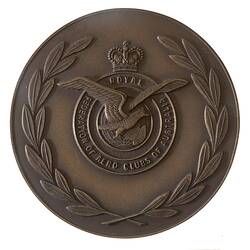
The Aero Club Federation of Australia (later the Royal Federation of Aero Clubs of Australia) provided development costs. -
Inscriptions
The letters VH-FMM are painted in black on the tail wing and the starboard wing
-
Model Name or Number
-
Brand Names
Airtourer (Aeroplanes) , Victa (Aeroplanes) , Vacuum (Petroleum Products)
-
Classification
-
Category
-
Discipline
-
Type of item
-
Exhibition Collection Management
6150 mm (Length), 7940 mm (Width), 2000 mm (Height)
-
Keywords