Summary
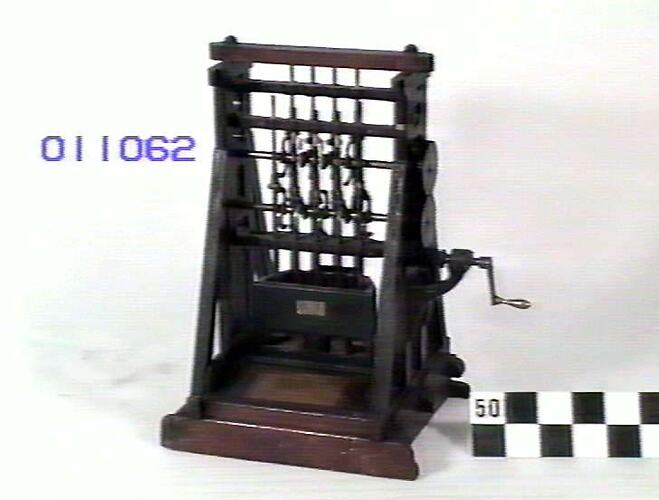
This battery consists of a series of nine stamps arranged alternately in two rows, and all working in one mortar box which discharges from all sides. Each row of stamps is driven by a separate cam shaft. Patented by engineer Arthur Hope, Prahran, Victoria, 1865.
The working model depicts Hope's invention designed to 'improve' the process of extracting gold from quartz ore. The model was exhibited at the 1866-67 Intercolonial Exhibition of Australasia and the 1872-73 Victoria Exhibition before being donated to the Industrial and Technological Museum.
Physical Description
Working model of a stamp battery. Includes a wooden base, superstructure and stamps, which appear to have been painted, then coated in what may be a plant resin. The wooden base has a paper diagram of the nine stamps in the housing adhered to it under the coating on one side. The battery is assembled with what appear to be both brass and steel screws. The working parts (cogs, operating handle, and curved devices which lift the stamps as the handle turns) appear to be made of brass. The housing around the stamps appears to be iron, painted black. Rubber and felt (probably woollen) layers occur underneath the stamps.
More Information
-
Collecting Areas
-
Acquisition Information
Transfer (Possible) from Unknown Source - Likely Donation
-
Patentee
Mr Arthur Hope, Prahran, Greater Melbourne, Victoria, Australia, 06 Mar 1865
Inventor & Patentee. -
Inscriptions
Brass plaque on the metal housing reads: 'ARTHUR HOPE/ PATENTEE/ 1865'.
-
Classification
Mining & metallurgy, Ore crushing - gold, Model stamp batteries
-
Category
-
Discipline
-
Type of item
-
Overall Dimensions
400 mm (Length), 500 mm (Width), 625 mm (Height)
Width includes handle
-
Maximum dimensions
370 mm (Length), 510 mm (Width), 620 mm (Height)
Measurement From Conservation.
-
Dimensions
41 cm (Length), 38 cm (Width), 63 cm (Height)
Measurement From Conservation.
-
Keywords