Summary
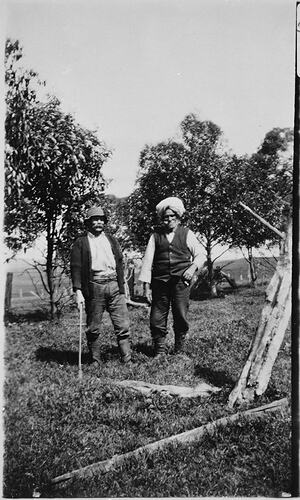
Black and white negative of Basil Pearce and visiting hawker, Rahn Singh, standing outdoors, presumably at Pearce's Farm, Carapook, Victoria, 1924. The photograph was taken by Arthur Pearce.
Hawkers played a vital role in connecting urban centres with rural settlements, often serving as a crucial source of support for isolated communities. They travelled alone on foot or by cart, supplying essential goods, as well as desirable non-essential items, that were otherwise difficult to obtain. In doing so, they became an integral part of the bush economy.
Hundreds of hawkers' licences were issued in Victoria each year. For instance, according to the National Archives of Australia, 120 hawkers' licences were issued by magistrates in 1898 in Victorian towns such as Ballarat, Bendigo, Echuca, Shepparton and Geelong. The licences were issued on a single, annual licensing day - a crowded and noisy event. In Melbourne alone 300 licences were issued in 1900. Indian hawkers and merchants generally came from Karachi, Peshawar, Baluchistan, the Punjab and Bengal. The tradition of hawking was common throughout rural India. The hawkers travelled through city and country areas, selling to city-dwellers and remote settlers alike. By the 1930s, hawkers were often immigrants from Europe.
The arrival of the motor car led to a decline in the livelihood of hawkers, as increasing numbers of rural households acquired their own means of transport. This greater mobility enabled farmers and their families to travel to towns and purchase goods directly, reducing reliance on itinerant traders.
Description of Content
Indian hawker and farmer on farm.
More Information
-
Collection Names
-
Collecting Areas
-
Acquisition Information
Copied from Irene Pearce, 13 Mar 1986
-
Place & Date Depicted
-
Creator
-
Individuals Identified
Pearce, Basil; Singh, Rahn
-
Format
Photograph, film base, Negative, 35 mm, Black & White
-
Classification
-
Category
-
Discipline
-
Type of item
-
Keywords