Summary
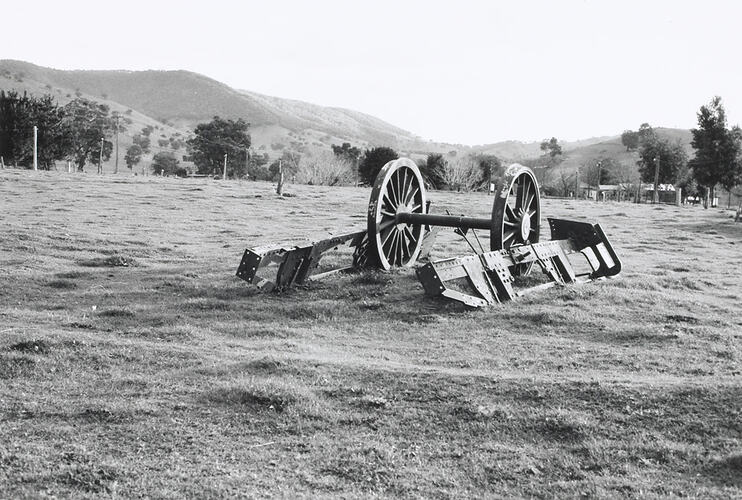
Print of a photographic image that appears in The Victorian Steam Heritage Register, p.99, together with the following caption: "Stranded like a beached whale, these surviving relics of one of Victoria's earliest steam locomotives now lie marooned in a paddock at Leneva, many miles from the nearest railway. The single wheel set and side-frames once formed part of an early 2-4-0 type tank locomotive built by Robert Stephenson & Co., of Darlington [sic - Newcastle-upon-Tyne], U.K., in about 1859. After over 30 years operating under both the Hobsons Bay Railway Co. and then the Victorian Railways, this engine was sold to a contractor working on the construction of the Beechworth to Yackandandah railway. Eventually, the engine found its way to a tin mine at Koetong, where it spent the last of its days working as a stationary steam engine."
Robert Stephenson & Co, of Newcastle, England, produced a total of 18 tank locomotives with the 2-4-0 wheel arrangement for Melbourne's privately-owned suburban railways companies between 1854 and 1870, with the first four being completed for the pioneering Melbourne & Hobsons Bay Railways Co., which inaugurated Australia's first steam-powered railway service over a 2¼-mile route between Melbourne and the deep water pier at Sandridge (later known as Port Melbourne) on Hobsons Bay in September 1854. The locomotives were of a conventional British design for the period with inside plate side frames and four large coupled driving wheels, outside cylinders and connecting rods. A single pair of leading wheels was situated between the cylinders with inside valve gear operated by Stephenson's type linkage from eccentrics in the centre of the forward driving axle. A fifth locomotive of a similar design was built for the same company in 1857. As the suburban railways were extended and traffic grew, further more powerful 2-4-0 tank locomotives were supplied by Stephenson's works with enlarged cylinders and driving wheels. The first five of these were supplied to the Melbourne & Hobsons Bay Railway Co in 1858-59, followed by two ordered by the Melbourne & Suburban Railway Co. in 1860, and another pair for the Melbourne Railway Co. in 1863. Between 1865 and 1870, a further five locomotives of similar design were built by Stephenson & Co. for the Melbourne & Hobsons Bay United Railway Co., which was formed by a merger of Melbourne's remaining private railway companies on 30 June 1865. During the early 1870s the five original locomotives and several of the later engines were withdrawn from service and sold. When the United company was merged with the government-owned Victorian Railways on 1 July 1878, the ten remaining Stephenson 2-4-0 tank locomotives still operating on the South Suburban railways were absorbed into the Victorian Railways fleet, being allocated shortly afterwards with even engine numbers 242 through to 260. Later when the Victorian Railways introduced a letter classification system for its various locomotive designs in 1886, the Stephenson 2-4-0 engines were allocated to N-class, although by this time five of the ten locomotives acquired had already been sold off to various railway contractors.
The remains of the Hobsons Bay locomotive at Leneva is believed to have been amongst the group sold off by 1886, probably being one of the two engines (builders nos. 1269 of 1859 or 1991 of 1870) sold to Nicholl, Gray & Tamlyn, contractors for the construction of the Tatura to Echuca Railway. The locomotive is reputed to have been used on the construction of the Beechworth to Yackandandah Railway in north-eastern Victoria, before finding its way to an alluvial tin mine at Koetong, near the News South Wales border, from where its remains were salvaged by members of the Border Steam & Oil Engine Club.
Description of Content
Relics of the earliest steam locomotives used in Victoria by the Melbourne & Hobsons Bay Railway Company, shown lying in a paddock at Leneva, north-east Victoria. The remains include two rivieted plate side frames with various cutouts, fixtures and holes and a pair of driving wheels with external crank pins, coupled by an axle. Some of the wheel spokes are broken.
Physical Description
Black & white photographic print from 35 mm negative.
Significance
Bendigo-based contractor George Pallet was awarded the contract for the construction of the 12¾-mile Beechworth to Yackandandah Railway on 2nd March 1889, at a price of £62,612. It is not known exactly from where Pallet acquired his locomotive, however, it may have been from Andrew O'Keefe, contractor for the construction of the Sandhurst (Bendigo) to Heathcote Railway, completed in October 1888, who had acquired at least one of Nicholl, Gray & Tamlyn's two secondhand Stephenson 2-4-0 type tank locomotives from the Victorian Railways, to assist with materials handling on their contract. Pallet also had an earlier association with Tamlyn, with whom he had been awarded a contract to construct the Footscray to Bacchus Marsh railway in 1882. Work on the Beechworth to Yackandandah railway commenced almost immediately after the contract was signed, and by 6th April it was reported that "about a hundred men, with horses and drays, are busily engaged in filling and cutting along the surveyed line from the Albert-road" at the Beechworth end of the route, with five hundred expected to be employed within the following month. By November 1889, good progress was reported to have been made with the first two bridges completed and plate laying having commenced for the first six miles of tracks. The contract involved heavy earthworks to tackle the steep grades encountered with some 419,000 cubic yards of spoil being excavated and shifted to create cuttings up to 33-feet deep and embankments up to 54-ft in height, together with the construction of 13 timber bridges and 87 culverts and railway station facilities at Wooragee and Yackandandah. The line was finally officially opened on 23rd July 1891, some eight months after the original planned completion date.
Geo Pallet's construction plant was advertised for sale by auction at Beechworth on 2nd September 1891, being described as: "Locomotive engine and trucks, pile engines, heavy ploughs, buggies, harness, riding saddles, portable forges, blacksmith's bellows, anvils and tools; also redgum timber, fencing, posts and rails, planks, wheelbarrows, 400 gal. tanks, sundries, &c." With new railway construction by then in almost complete abeyance following the collapse of the land boom, there appears to have been little interest in the sale and the plant remained unsold. In February 1893, Geo Pallet's plant was readvertised for sale as part of an insolvent estate with the description including: "1 Locomotive, by Stephenson and Sons, stripped and ready for removal; with Tools, Tarpaulin, &c.; 20 Ballast Waggons, in good order .". Again the plant appears to have gone unsold and remained on site in Beechworth, where it was re-advertised for auction by Pleasance, Graham & Styles in March 1901, being described as: "LOCOMOTIVE, by Stephenson, 5ft. 3in. gauge, 4-wheel couple; cyls. 11in. dia., by 21 in. stroke" with "20 BALLAST WAGGONS, 6 yards capacity, 5ft. 3in. gauge, with iron frames, on springs", together with other equipment "formerly used by Mr. Geo. Ballett in construction of Beechworth to Yackandandah railway".
More Information
-
Collection Names
-
Collecting Areas
-
Acquisition Information
Collected from Scienceworks, Museum of Victoria, Steam Heritage Survey, 1993
-
Place & Date Depicted
Border Steam & Oil Engine Club, Beechworth-Wodonga Road, Leneva, North-East, Victoria, Australia, Mar 1989
-
Photographer
-
Format
Photograph, paper base, Silver gelatin print, Black & White
-
Classification
Rail transport, Railways - steam power, Steam passenger locomotives
-
Category
-
Discipline
-
Type of item
-
References
'AN EXCELLENT COMBINATION', Ovens & Murray Advertiser (Beechworth), 6 April 1889, p.6, from [Link 1] [Advertising], The Age (Melbourne), 22 Aug 1891, p.2, from [Link 2] [Advertising], Ovens & Murray Advertiser (Beechworth), 18 Feb 1893, p.3, from [Link 3] [Advertising], The Argus (Melbourne), 20 Mar 1901, p.2, col.4, from [Link 4]
[Book] Churchward, Matthew. 1995. The Victorian Steam Heritage Register., pp.99-100 & 110 Pages
[Book] Cave, Norman, et al. 2002. Steam Locomotives of the Victorian Railways, Volume 1: The First Fifty Years. 1., pp.5-17, 95-96 & 104 Pages
[Book] Larsen, Wal. 1976. The Mayday Hills Railway.
-
Keywords
Rail Transport, Railways, Steam Railway Locomotives, Steam Railway Locomotive Components