

Summary
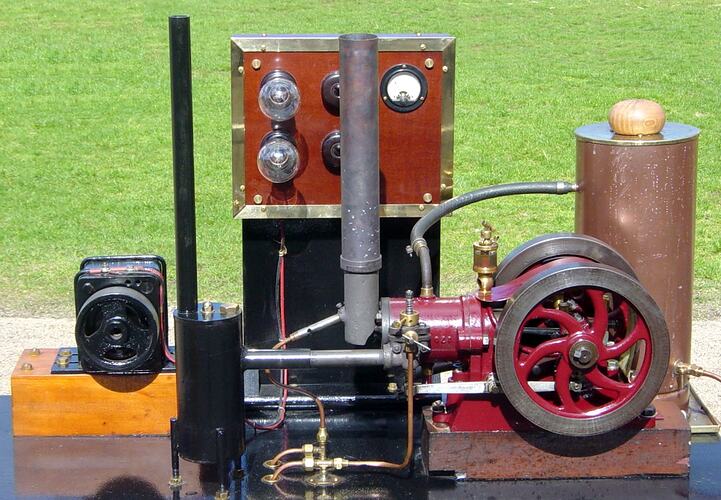
A single-cylinder horizontal stationary gas engine of unknown make but very similar to a Stuart Turner type. The engine has a small 'hot tube' heated by an external gas burner, which ignited the incoming fuel & air mixture after compression.
It was used to power an electric lighting dynamo in a shop at Williamstown, circa 1900. Prior to the introduction of a municipal electricity supply in Williamstown in 1917, small gas engines like these were used to generate electrical power for small shops and businesses.
This engine was restored to operable condition by staff and volunteers at the Scienceworks Engineering Workshop.
Physical Description
2-inch (50mm) diameter bore by 3-inch (75mm) stroke. Open-crank type, with hot-tube ignition, sight-feed cylinder oiler, twin curved-spoked flywheels and wooden belt-pulley. It has been coupled to an electric dynamo (of unkown make), but a similar date, to power a lighting display for demonstration purposes.
Significance
The gas engine is fundamental to any understanding of the development of internal combustion engines and their widespread application during the twentieth century to such diverse applications as the motor car, ocean liner, aeroplane and lawn mower. The gas engine was a transition technology. It represented the first practical internal combustion engine developed and the first to be widely utilised. Its origins, however, were rooted in the technology of the steam engine, borrowing heavily in the thermodynamic science, designs and manufacturing techniques developed during the late eighteenth and early nineteenth centuries to produce better steam engines.
The concept of an internal combustion engine dates back to at least 1680 when Huygens experimented with an engine driven by small explosions of gunpowder. Renewed interest developed towards the end of the 19th century, but it was not until 1876 that the German engineer, Nicolaus August Otto (1832-1891) came up with the first practical gas engine design, known as the "four-cycle" or "Otto silent type". He succeeded where other inventors had failed, by compressing the incoming gas mixture before ignition and by employing valves to regulate the flow of gases and timing of the ignition point.
Gas engines first appeared in Victoria around 1878 and were quickly taken up with some 41 factories using gas-powered engines by 1880, primarily in the printing, aerated water, jewellery, boot & shoe making and clothing industries. By 1896, some 17% of Victoria's 2,810 powered manufactories were using gas engines. After 1900, the spread of reticulated electricity supplies saw the use of gas engines in the metropolitan area decline, but they remained popular in country districts for another 20-30 years, primarily because of the development of gas producers, which could generate cheap gas from low grade fuels such as coke and charcoal.
More Information
-
Collecting Areas
-
Acquisition Information
Donation from Mr Vic Williams, 16 Sep 1998
-
Manufacturer (Probable)
-
Brand Names
-
Classification
Mechanical engineering, Internal combustion power, Gas engines
-
Category
-
Discipline
-
Type of item
-
Overall Dimensions
500 mm (Length), 660 mm (Width), 300 mm (Height)
Mounted on a 730 mm by 175 mm timber base. Flywheels measure 230 mm diameter, with 30 x 23 mm rim.
-
Keywords