Summary
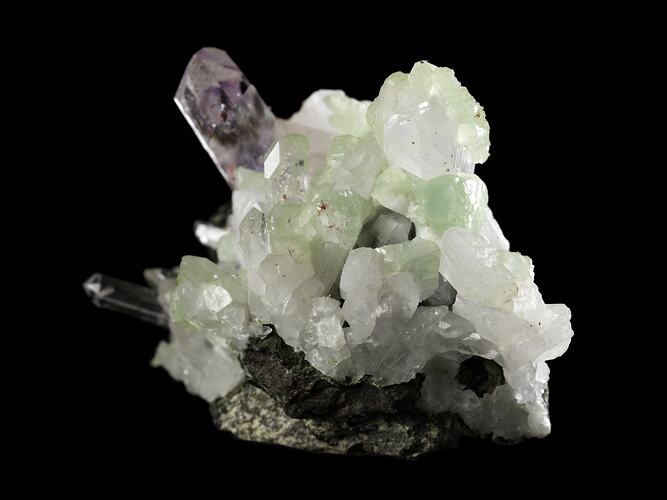
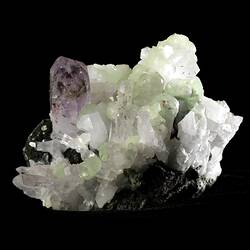
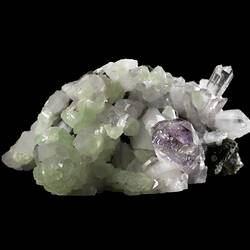
Prehnite is usually a pale green but sometimes it appears darker or may have a yellow or white tint. It can sometimes be used as a gemstone, usually as cabochons or beads rather than other gem cuts as it is not fully transparent. It forms a range of shapes including globular, sometimes spherical or kidney-shaped forms or, rarely, more prismatic, blocky crystals.
Prehnite is known from around the world, including various parts of Africa, China, Australia and New Jersey in the US. This specimen came from the Goboboseb Mountains in Namibia, an area known for the variety and quality of gems it produces.
Prehnite was described in 1788 from the Karoo dolerites in South Africa by German geologist Abraham Werner (1749-1817). It was named after Colonel Hendrik Von Prehn (1733-1785), the South African commander of the Dutch military forces at the Cape of Good Hope from 1768 to 1780, who discovered the first samples. It was the first mineral to be named from South Africa.
Specimen Details
-
Number Of Specimens
1
-
Specimen Nature
Form: Hand Specimen(s)
-
Species
-
Group
-
Class
-
Associated Matrix
Amethyst, quartz
-
Category
-
Scientific Group
-
Discipline
-
Collecting Areas
-
Type of Item
Geospatial Information
-
Country
-
State