Summary
Alternative Name(s): Accident Data Recorder; Aircraft Data Recorder; 'Black Box' Recorder
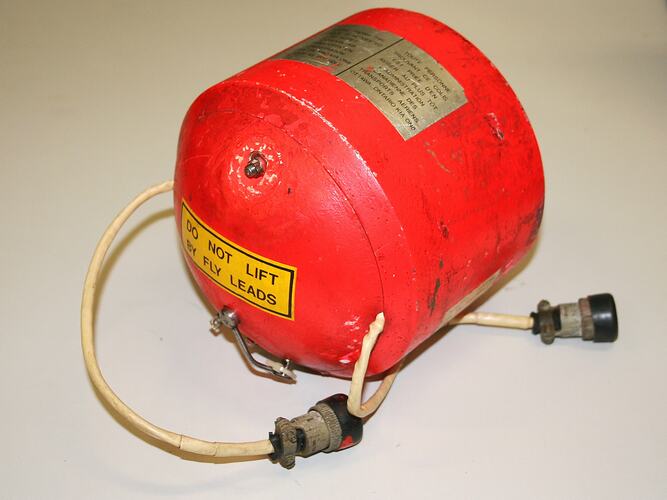
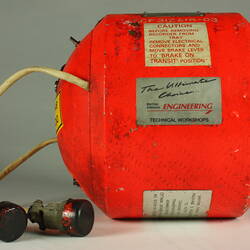
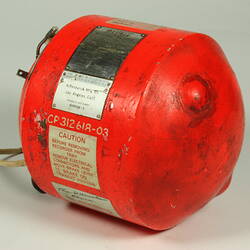
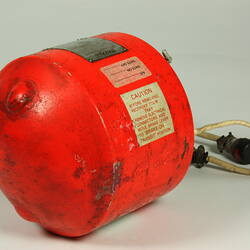
Crash-protected recycling wire flight data recorder housed in an armoured and insulated cylindrical casing. Manufactured by S. Davall & Sons Limited, 8 Wadsworth Road, Greenford, London, England. Type 1190, Serial No.172, circa 1969.
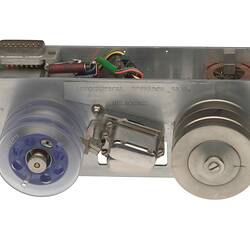
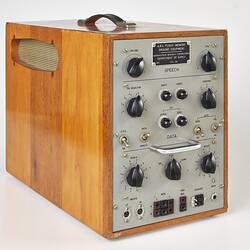
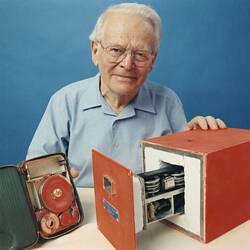
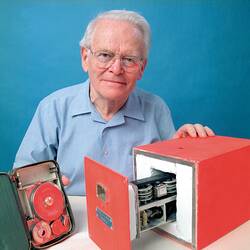
Dr David Warren of the Aeronautical Research Laboratories (ARL), Fishermans Bend, Melbourne, is generally attributed as the inventor of the metal wire flight data and cockpit voice recorder - originally known by the title 'ARL Flight Memory'. He first developed the concept in 1953 or 1954, while serving as a member of a multi-disciplinary committee investigating possible causes of a series of unexplained catastrophic crashes that had plagued the introduction of the British-built de Havilland Comet aircraft - the world's first jet airliner. The concept was based on the recording technology of a German-built 'Minifon' portable audio recorder, which used a magnetised metal wire to record a single track of audio - originally intended for use as a dictaphone or for recording live music.
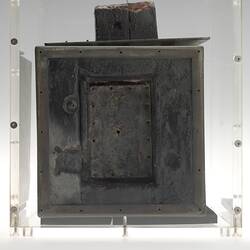
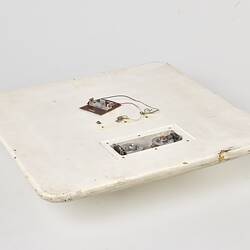
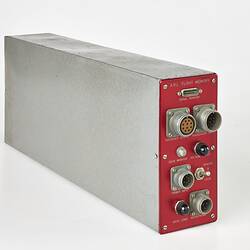
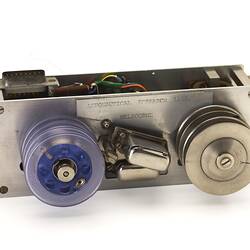
Electronic instrument maker Theon Numa ('Tych') Mirfield was commissioned by ARL to build a working prototype of Warren's design in 1958 (see ST 033195), which underwent flight testing in a Fokker Friendship F-27 aircraft owned by Australia's Department of Civil Aviation (DCA), proving that the concept would work. Crucially ARL failed to patent the invention, because they initially believed that it would have only a limited commercial application - perhaps limited to a few prototype aircraft undergoing flight testing. Further development of the design was undertaken by ARL during 1960-1962, with electronics engineers Kenneth Fraser and Lane Sear, and technician Walter Boswell being brought in to develop the airborne encoder and ground-based decoding units (ST 033210 and ST 033208), required to combine both audio and multiple instrument readings into a multiplexed analogue signal that could be saved on the single recording track. In 1963, David Warren and a technician travelled to the United Kingdom to demonstrate the unit to S. Davall & Sons, who had expressed interest in commercial development of the design. After extensive discussions, negotiations broke down over licensing arrangements and a request that the Australian-partner fund an experienced instrument engineer to work on the project for six-months in Britain. As the original design was not patent protected, Davall decided to proceed on its own. It was another missed opportunity in which the Australian Government and industry failed to capitalise on an original breakthrough by Australian research scientists.
Davall worked with British European Airways (BEA) to develop their Type 1050 Series Long-Duration Flight Data Recorder which was released in 1965. It used a cassette with two reels of fine stainless steel wire on which data from up to six cockpit instruments could be simultaneously recorded over four hours of flight, before being removed and replaced with a new cassette. Less than 12 months later, on 26th October 1965, a BEA Vickers Vanguard turbo-prop airliner carrying a Davall recorder crash landed at London's Heathrow Airport in heavy fog, killing all 36 passengers and crew. The recorder was recovered from the burnout wreckage and yielded valuable data that assisted in the accident investigation. Subsequently Davall would make the claim that their equipment was 'Crash Proven' when marketing new flight recorders.
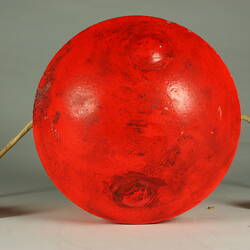
Davall's second generation of flight recorders, the 1100 Series, were introduced in 1967. They quickly became known as the 'Red Egg', because the recording device was protected from fire and impact by a small insulated cylinder with domed ends, painted in a bright fluorescent orange so that it could be easily located amongst crash wreckage. The 1100 Series 'Red Egg' flight recorders were the world's first commercially available flight recorders to incorporate both a recycling wire recorder and allow the simultaneous recording of both voice and data - both key features of David Warren's original design. The Type 1190 recorder, first released in 1968, allowed up to 55 hours of continuous recording before the device automatically 'recycled' by erasing and re-recording over the previous signal. It could withstand sudden deceleration of up to 1,000g (one thousand times gravity), could resist a crush loading of 2.25 tonnes and withstand a fire of up to 1,100 °C for 30 minutes, without any loss of data. It could record up to 100 parameters per second from six instruments, or a combination of voice and data, and was designed as a 'fit and forget' device requiring minimal maintenance. By mid-1968, Davall Flight Recorders were in use with over 15 airlines worldwide and had accumulated over one million flying hours, successfully recording flight data associated with 84 incidents. The company also supplied flight recorder units for equipment made by other manufacturers such as Plessy Garrett-AiResearch, Epsylon, Bendix, United Control Corporation, SFIM and Sperry.
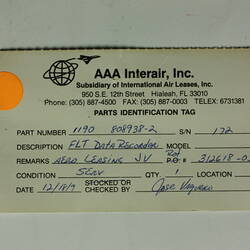
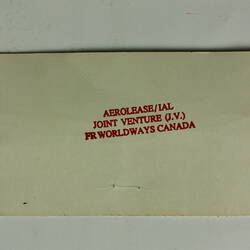
This Type 1190 recorder appears to have a service history with British Airways and Worldways Canada Ltd. It was last serviced in August 1990. British Airways was formed in 1972 by the merger of British government-owned British Overseas Airways Corporation (BOAC) and British European Airways (BEA). The airline was privatised in 1987. During the period when this flight recorder was in service British Airways flew mainly BAC One-Eleven, Boeing 707, 737, 747, Lockheed Tristar, Vickers VC-10, Vickers Viscount and Vickers Viscount aircraft types, and the Aérospatiale-BAC Concorde. Worldways was a Canadian charter airline founded by Roy Moore in 1973, which flew McDonnell Douglas DC-8, Boeing 707, Boeing 727, Convair 640 and Lockheed L-1011 TriStar aircraft. It ceased operations on 11 October 1990 and went out of business in 1991.
Physical Description
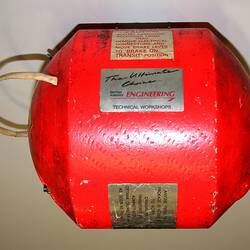
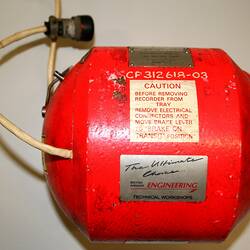
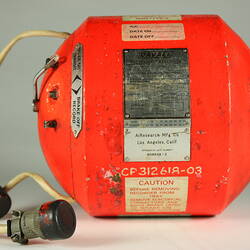
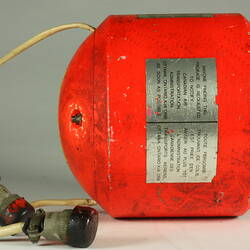
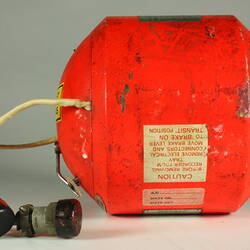
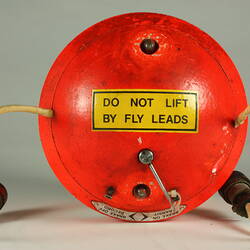
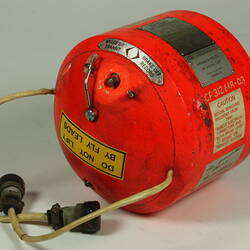
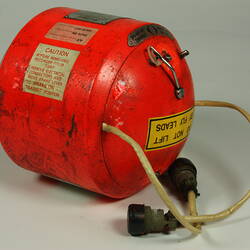
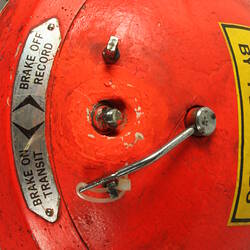
Metal cylindrical casing, about 6-inches (150 mm) diameter, with 7-inch (178 mm) diameter spherical domed ends, painted florescent orange-red on outside with various metal identification plates and adhesive labels fixed to surface. Two flexible plastic insulated electrical 'fly wires', with aluminium multipin plugs fixed to their out ends, protrude from a circular access cover on one end of the casing. The access cover is fixed in place with two hex-head bolts, which when removed, allow the internal mechanism and recorder to be withdrawn. A small metal lever also extending from the access cover can be rotated through 90 degrees to lock or release the brake on the recorder mechanism.
More Information
-
Collecting Areas
-
Manufacturer
S. Davall & Sons Limited, England, Great Britain, circa 1969
-
Inventor
Dr David R. Warren - Aeronautical Research Laboratories (ARL), Lorimer Street, Fishermans Bend (Fishermen's Bend), Port Melbourne, Greater Melbourne, Victoria, Australia, circa 1954
-
Other Association (See Comments)
Mr Theon ('Tich') N. Mirfield, Melbourne, Greater Melbourne, Victoria, Australia, circa 1958
Theon Numa Mirfield (known to associates as 'Tych' Mirfield), was a mechanical and electrical engineer and expert instrument maker. He was involved in designed and building the 'recycling' wire recorders that were at the heart of both the first (c.1958) and second (c.1960) prototypes of the cockpit voice and flight data recorder invented by David Warren at the Aeronautical Research Laboratories, Port Melbourne. -
User
British Airways, London, Middlesex, England, Great Britain, circa 1972-1985
-
User
Worldways Canada Ltd, 6299 Airport Road, Mississauga, Ontario, Canada, circa 1980-1990
-
Inscriptions
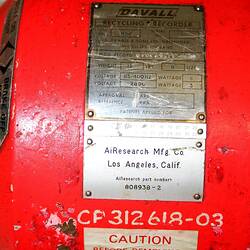
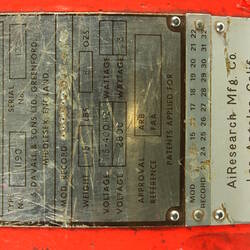
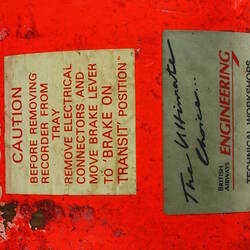
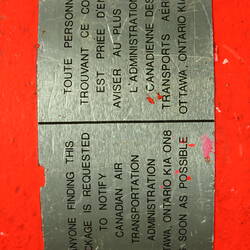
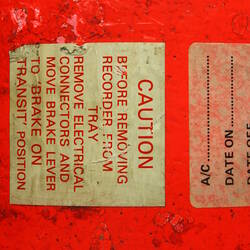
Manufacturer's plate: '[DAVALL] / [RECYCLING RECORDER] / TYPE No. 1190 / SERIAL No. 172 / S. DAVALL & SONS LTD., GREENFORD, / MIDDLESEX, ENGLAND / MOD RECORD [obscured] / WEIGHT 15 LBS. 8 OZS. / VOLTAGE 115-400 HZ / WATTAGE 6 / VOLTAGE 28DC/ WATTAGE 3/ APPROVAL ARB / FAA / PATENTS APPLIED FOR' Supplier's plate: 'AiResearch Mfg. Co. / Los Angles, Calif. / AiResearch part number:- / 808938 - 2' Lettering in white paint below above plate: 'CP 312618-03' Adhesive label with red printed lettering: "CAUTION / BEFORE REMOVING / RECORDER FROM / TRAY / REMOVE ELECTRICAL / CONNECTORS AND / MOVE BRAKE LEVER / TO 'BRAKE ON / TRANSIT' POSITION" Metallic adhesive label below this reads: "The Ultimate / Choice ' BRITISH AIRWAYS ENGINEERING / TECHNICAL WORKSHOPS" Silver metallic adhesive label on underside reads: "ANYONE FINDING THIS / PACKAGE IS REQUESTED / TO NOTIFY / CANADIAN AIR / TRANSPORATION / ADMINISTRATION / OTTAWA, ONTARIO KIA ON8 . AS SOON AS POSSIBLE." | "TOUTE PERSONNE / TROUVANT CE COLIS / EST PRIEE D'EN / AVISER AU PLUS TÖT / L'ADMINSTRATION / CANADIENNE DES / TRANSPORTS AERIENS / OTTAWA, ONTARIO KIA ON8" Yellow adhesive label with black border and text on end of unit reads: "DO NOT LIFT / BY FLY LEADS" Near the top of one end: arrows pointing in opposite directions, one labelled 'BRAKE ON / TRANSIT' and the other 'BRAKE OFF / RECORD'
-
Model Name or Number
-
Brand Names
-
Classification
-
Category
-
Discipline
-
Type of item
-
Overall Dimensions
200 mm (Length), 180 mm (Width), 180 mm (Height), 180 mm (Outside Diameter), 6.5 kg (Weight)
External dimensions of fire-proof casing only. Two flexible external leads attached measure 290 mm L each.
-
Keywords
Aircraft Safety Equipment, Aircraft Equipment, Aircraft Instruments, Airlines, Aviation, Inventions, Innovation & Design, Flight Recorders