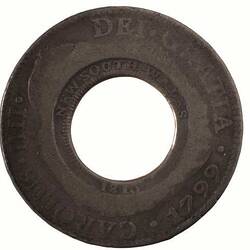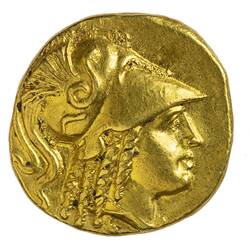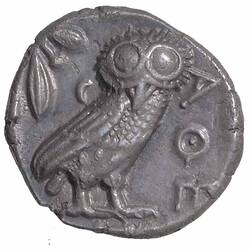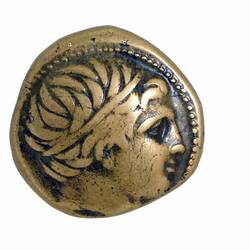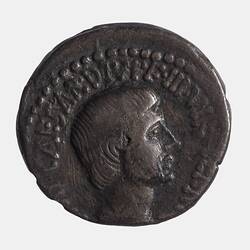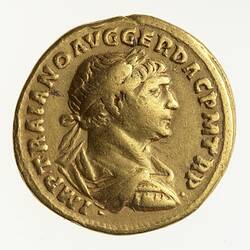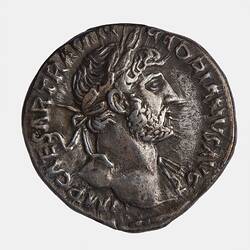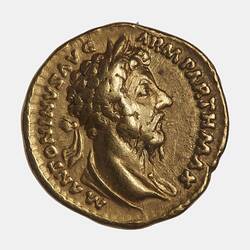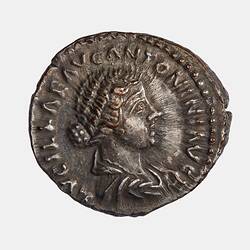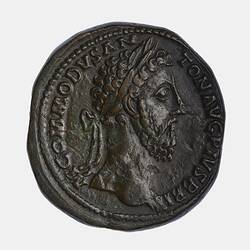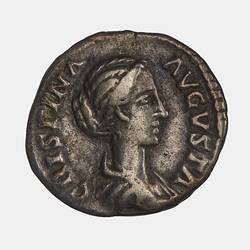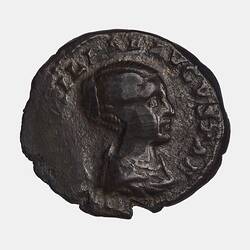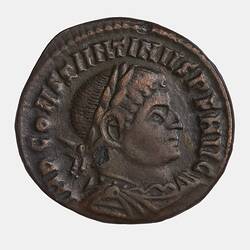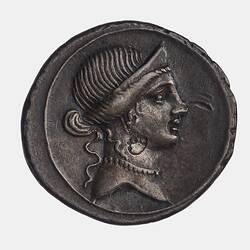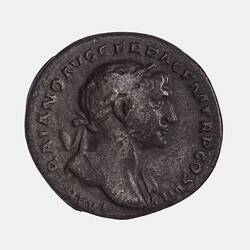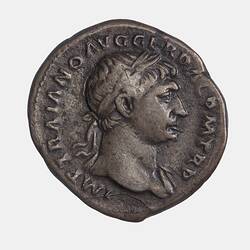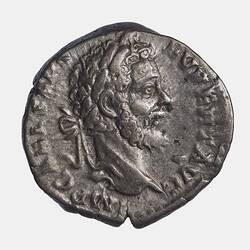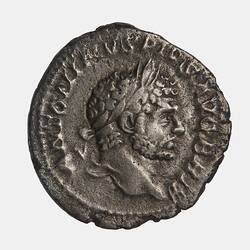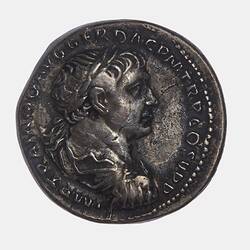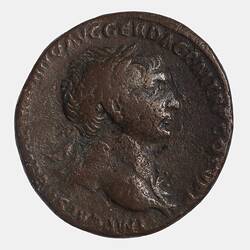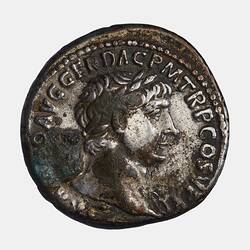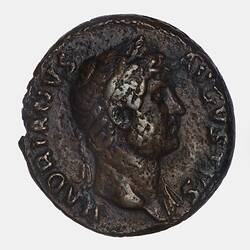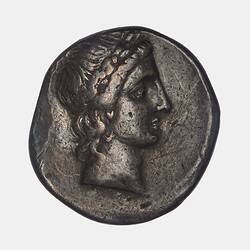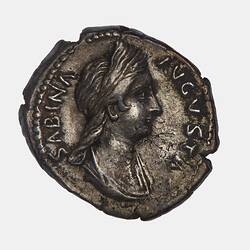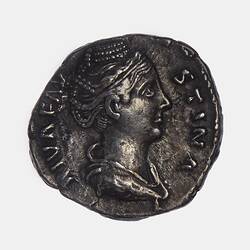
Museums Victoria's numismatics collection contains an extensive number of ancient coins spanning the empires of Rome, Greece, Egypt, and the ancient Near East. There are approximately 1850 ancient Roman coins, as well as over 1400 electrotype copies of Roman coins.
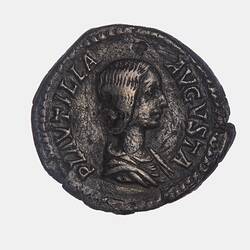
The collection covers all periods of the history of Rome: from the Republic (199 items); to the height of the Roman Empire (1577 items); to the later Byzantine age (80 items). The majority of the coins relate to the time of the empire and include coins issued by emperors for themselves, and in the name of their sons, wives, mothers and daughters.
History of the collection
Many of these coins came from the private collection of landscape artist Eugene von Guerard who was also the first curator of the numismatics collection, then held by the National Gallery of Victoria. He sold it to the gallery after he retired in 1881. The gallery transferred the entire numismatics collection to the museum in 1976.
Other Roman coins have occasionally been acquired through coin auctions in the years since and through a transfer of about 150 Roman coins from the Melbourne Branch of the Royal Mint historical collection in 1978. The electrotype copies were purchased from the collection of the British Museum from the 1870s until 1933.
Ancient coins tend to be discovered in archaeological digs, and many of the most exquisite ones are found in burials or hoards. Hoards are large deposits of coins, jewels and metal objects buried for safekeeping by ancient people fleeing attack but never making it back to retrieve them.
Coin denominations
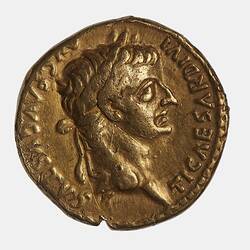
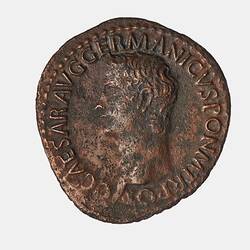
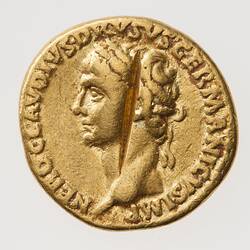
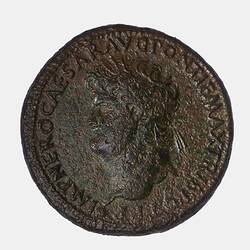
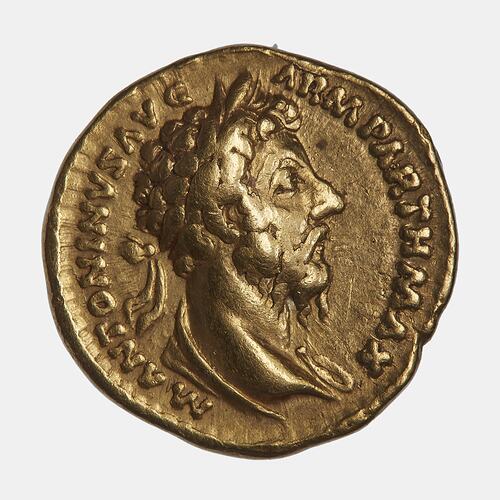
The Romans adopted the idea of coins from the ancient Greeks and used them across the empire to promote themselves. The main denominations were the as (bronze, the base unit) (NU22552), the sestertius (bronze, equalled four asses) (NU22585), the denarius (silver, equalled four sestertii) (NU22766) and the aureus (gold, equalled 25 denarii) (NU15537).
What were the coins worth?
Ancient Roman coins didn't have a value written on them as modern coins do. Their value was determined by the precious metals they were made of (gold, silver, bronze, orichalcum (brass), and copper) and their weight. The heavier and more precious the metal, the more expensive the coin.
One as could buy a cheap cup of wine, and a sestertius could buy two loaves of bread. The denarius was the most common coin and was the average day's pay for an everyday Roman. It could buy an amphora of good quality wine or olive oil. The minting of aureii was strictly controlled and they were rare even in ancient times. A legionnaire would have been paid one aureus for a month's salary, although it was unlikely that he would have been paid with a gold coin.
Depicting power
As well as buying goods and services, coins enabled emperors to promote themselves, their achievements and to unify the economy. This unification was especially achieved as the currency travelled across their empire. Every emperor from Augustus to Hadrian to Constantine the Great had their portrait on a coin.
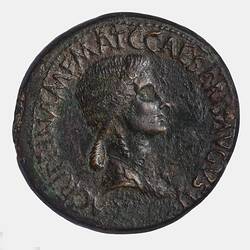
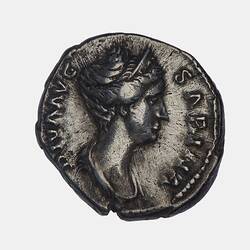
Imperial women also depicted themselves on coins to further their political ambitions and influence, including Agrippina (NU22553) and Sabina (NU22813). When using coins, everyone in the empire knew exactly who was in power.
Yet there was a hidden cost to coin production. Enslaved peoples toiled in dark and dangerous mines in Iberia (now Spain and Portugal) to extract the precious metals.
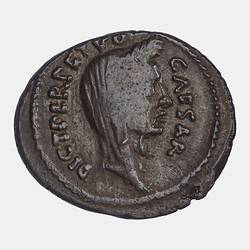
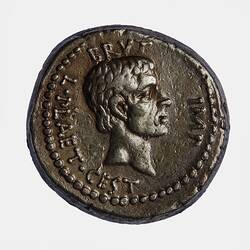
Julius Caesar was the first living human to be portrayed on a Roman coin. He even depicted himself as he really was, an older man (NU2186). Later, Marcus Junius Brutus, one of his assassins, issued a coin in commemoration of Caesar's death. On the coin, he included the date EID MAR, 'the Ides of March' (15 March 44 BCE) of the assassination and some daggers to drive the point home (NU57985).
Images of military power
As coins were exchanged across the empire, they promoted the authority of the Romans (NU2832). The coins usually depicted the strong and powerful emperor as the focus. For example, Augustus is depicted as a heroic emperor with his cape flying in the wind (NU22500), Trajan is on horseback fighting alongside his army (NU22726), and the subjugated Dacians are shown in mourning next to the spoils of war (NU22753 and NU22720).
Hadrian produced a coin depicting a galley, a long ship with rowers, on the reverse representing his extensive travels across the Empire and the might of Roman maritime power (NU22807). Further, on one coin, Augustus appears ploughing a field for the Roman population, providing sustenance for them in peace (NU22501).
Fashion dictators - Roman hairstyles depicted on coins
As we do today, ancient Romans took pride in their appearance and used it to exhibit their individuality. In this way, hairstyles often revealed people's status and societal roles.
Of course, fashions changed with each new dynasty. Some women's hair became very elaborate (NU25015) with braids, curls, and extensions (NU22848), although the tutulus (cone-shaped bun) was worn throughout the Imperial age (NU22941). The images of Imperial women on coins reflected these styles and promoted the latest fashion.
The emperor Caracalla reigned from the age of ten and was depicted as a child with large curls (NU22981). Augustus once had three barbers simultaneously cut his hair to save time (NU22515). Hadrian, fascinated with Greek culture, was the first Emperor to wear a full beard (NU22769).
References:
Sharples, J 1986 'The Numismatic Collection of the Museum of Victoria', Journal of the Numismatic Association of Australia, vol. 2, pp. 37-52.
Pullin, R 2011 Eugene von Guerard: Nature Revealed, National Gallery of Victoria, Melbourne.
More Information
-
Keywords
-
Localities
-
Authors
-
Article types